Search for kimchi’s health benefits and you get two useless piles of results: wellness sites promising it’ll transform your gut, and skeptics waving at the sodium as if that settles the matter. Neither one tells you what’s actually in a serving, which claims rest on human trials versus petri dishes, or how much of the “probiotic” story survives a month in your fridge — let alone a hot pan. What follows sorts the evidence by how strong it really is, labels each benefit with the kind of study behind it, and puts the sodium trade-off on the same page as the upside instead of burying it at the bottom. By the end you’ll have enough to decide whether a daily side of kimchi earns a spot on your plate.
What Kimchi Actually Is — and Why Fermentation Changes the Food
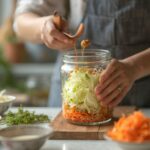
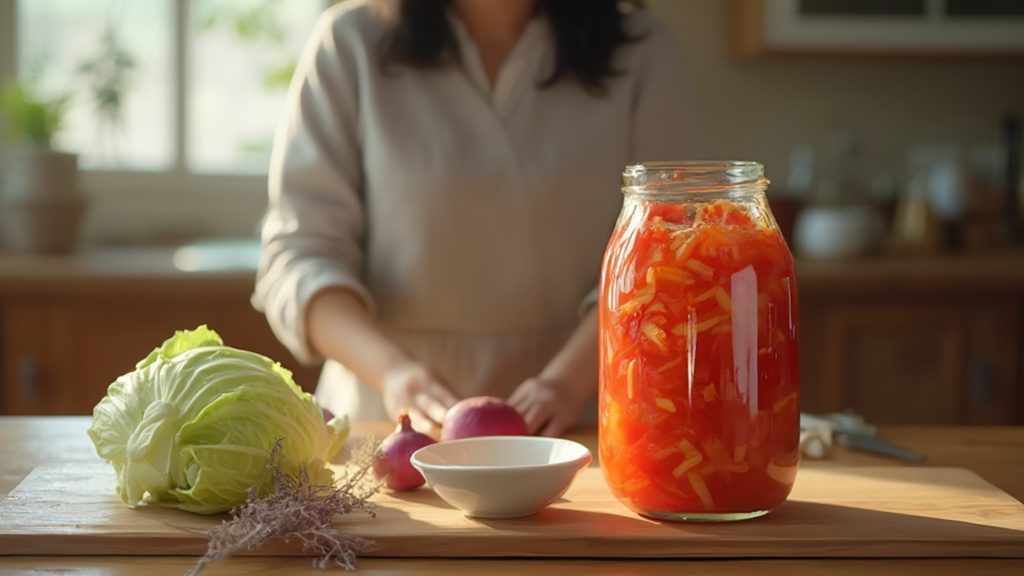
Kimchi is salted vegetables fermented by lactic acid bacteria, and that last part is what separates it from a pickle. A dill pickle sits in vinegar; the acid comes out of a bottle. Kimchi makes its own. Bacteria already living on the cabbage leaves eat the sugars in the vegetables and produce lactic acid as they go, which is why a jar left on the counter for three days tastes sharper than the one you sealed yesterday.
Start with what goes in. The most common version, baechu kimchi, uses napa cabbage — the pale, oblong one, not the round green head. The cabbage gets salted first, which pulls water out of the leaves and makes them pliable. Then comes the seasoning paste: gochugaru (Korean red pepper flakes, coarser and fruitier than cayenne), garlic, ginger, scallion, often grated Korean radish, and in most traditional recipes some form of salted seafood — jeotgal, usually fermented shrimp or anchovy sauce. Vegan versions swap that for kelp or mushroom broth, and they ferment just fine.
Here’s the part most articles skip. The salt isn’t only for flavor. It creates conditions where most spoilage organisms can’t survive but salt-tolerant lactic acid bacteria can, so those bacteria take over by default. Early on, Leuconostoc species dominate and produce the fizzy, mildly sour stage Koreans call fresh kimchi. As the acidity climbs, Lactobacillus and Weissella species take the lead and the flavor turns deeper and more sour. That succession is why the same jar tastes like a different food in week one than in week six, and it’s why my grandmother kept two containers going at once — fresh for eating raw, sour for cooking. I walk through the microbial timeline in more detail in .
So what does fermentation actually change about the food? A few things worth naming:
- Acidity. The pH drops, which preserves the vegetables without heat and gives kimchi its tang.
- Live microbial content. A finished, refrigerated jar carries substantial populations of live lactic acid bacteria — something raw cabbage doesn’t have in meaningful numbers.
- Compound profile. Fermentation breaks down and transforms some plant compounds. Research on fermented vegetables has documented shifts in certain nutrients and bioactive compounds, though whether that translates into measurable effects in people is a separate question I’ll get to.
- Digestibility and flavor. The bacteria pre-digest some of the plant material, which is part of why fermented cabbage sits differently than a pile of raw cabbage.
One clarification that shapes everything downstream: not all kimchi on a US shelf is still fermenting. Some shelf-stable jars are pasteurized, which kills the live cultures. Refrigerated kimchi is generally still alive and still changing — that’s why the lid sometimes pops when you open it. That distinction ends up mattering for almost every question that follows.
What’s in a Serving: The Nutrition Profile
Kimchi is a low-calorie, high-water vegetable food with modest fiber, a real dose of vitamins A, C, and K from the cabbage and pepper, and a sodium load that runs from meaningful to substantial depending on the brand. That’s the honest summary. The numbers vary more than most nutrition articles let on, because kimchi isn’t a standardized product — USDA FoodData Central entries differ from brand to brand, and homemade versions vary more still.
Calories, fiber, and macronutrients per 100 g
A 100-gram portion — roughly a half cup, a bit more than a typical Korean side-dish serving — is low in calories. USDA FoodData Central lists kimchi at roughly 15 to 30 calories per 100 g depending on the entry, with a couple grams of carbohydrate and around 1 to 2 grams of protein. It’s mostly water.
The fiber is real but not remarkable: on the order of 1 to 2 grams per 100 g in USDA listings. That’s a contribution, not a solution. For context, the Dietary Guidelines for Americans put adult fiber targets in the 25 to 34 gram range depending on age and sex. A daily side of kimchi covers a thin slice of that. If you’re eating kimchi specifically for fiber, beans will serve you better. What kimchi adds is fiber plus fermentation, and that combination is the actual argument — more on it shortly.
There’s essentially no fat and no added sugar in traditional kimchi, though some commercial recipes include a little sugar or rice flour paste to feed the fermentation. Check the label if that matters to you.
Vitamins and carotenoids from the vegetables
Kimchi carries the vitamin profile of its ingredients, and napa cabbage is a decent source of vitamin C and vitamin K. Gochugaru contributes carotenoids — the pigments that make it red — including beta-carotene, which the body converts to vitamin A. Scallions and Korean radish add more of the same.
Two caveats worth holding onto. First, vitamin C degrades with time, heat, and oxygen exposure, so a jar that’s been open in your fridge for two months isn’t delivering what a fresh batch did. Second, portion size limits everything here. Kimchi in Korean meals is a side dish — banchan — not a salad course. Nobody eats two cups of it. The vitamin contribution from a realistic serving is a supporting player, not a main source.
That’s worth being blunt about, because it’s where a lot of English-language kimchi content quietly inflates the case. Listing every vitamin in a food tells you nothing if the serving is 40 grams.
Sodium: the number people skip past
This is the number that actually changes how you should eat it. Kimchi is salt-preserved, and USDA FoodData Central entries commonly put its sodium at roughly 400 to 800 mg per 100 g, with brand-to-brand variation on either side. A realistic 50-gram side serving lands somewhere around 200 to 400 mg.
Set that against the guidance. The FDA advises adults to limit sodium to less than 2,300 mg per day and notes that Americans currently average well above that — closer to 3,400 mg. The American Heart Association goes further, citing an ideal limit of 1,500 mg per day for most adults, particularly those with high blood pressure.
So a daily serving of kimchi isn’t, by itself, a sodium problem for most people. It’s a line item. Whether it’s a comfortable line item depends entirely on the rest of your day — and if that day includes deli meat, restaurant food, canned soup, or bread (which contributes more sodium to the American diet than most people expect), the math tightens fast.
I put the sodium in the same section as the vitamins rather than quarantining it in a “risks” box at the bottom because they come from the same jar. You don’t get one without the other. An honest read of kimchi’s nutrition holds both at once: a genuinely nutrient-carrying fermented vegetable that also brings salt to the table. How much of it fits into a normal week is a question I take up separately in How Much Kimchi Should I Eat Per Day? A Practical Guide.
The Probiotic Question: What Live Cultures Do and Don’t Do
Kimchi is a fermented food that contains live microbes — but calling it a “probiotic” is technically wrong, and the distinction isn’t pedantry. It changes what you should expect from it.
The definition most researchers work from comes out of a joint FAO/WHO consultation and was refined by the International Scientific Association for Probiotics and Prebiotics (ISAPP): probiotics are live microorganisms that, when administered in adequate amounts, confer a health benefit on the host. Every clause there does work. To qualify, an organism has to be identified down to the strain, delivered in a known dose, and shown in studies to do something beneficial.
Kimchi clears none of those bars. ISAPP has published guidance drawing exactly this line: fermented foods and probiotics aren’t the same category. A jar of kimchi holds an undefined mix of Leuconostoc, Lactobacillus, Weissella, and other species whose proportions shift week to week as the ferment matures. Nobody has characterized the strains in the jar in your fridge, nobody has counted them, and no trial has tested that particular microbial community for a specific outcome. It’s a live food, not a dosed intervention.
That’s not a knock on kimchi. It’s a correction to the framing. Here’s what it means in practice.
The count varies enormously. Live bacteria in fermented vegetables depend on how long the batch fermented, how cold it’s been kept, and how long it’s been open. Two jars from the same store can differ by orders of magnitude. There’s no label number to check, because manufacturers aren’t required to enumerate live cultures the way a probiotic supplement is.
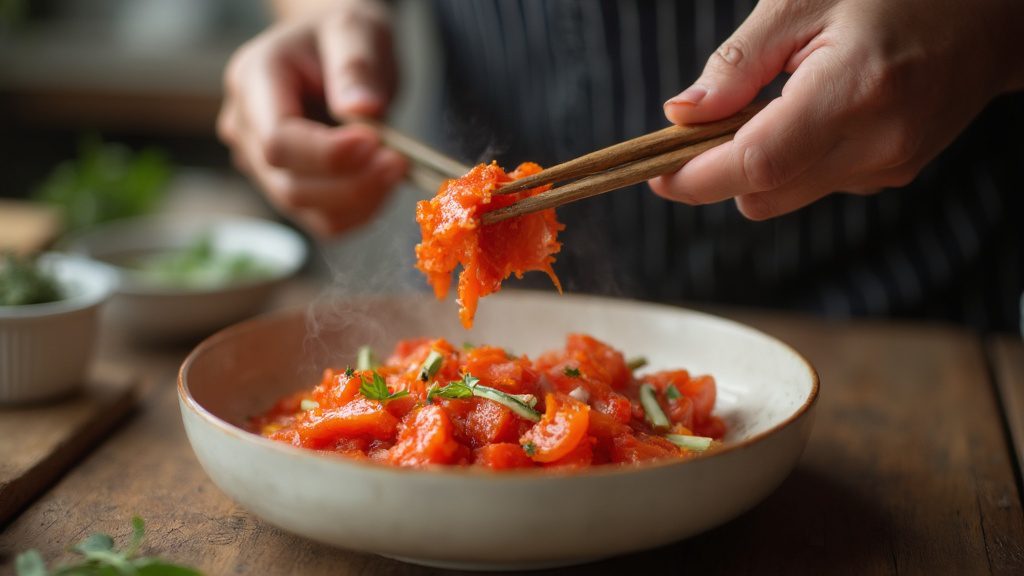
Heat ends it. Pasteurized kimchi has no live cultures by design. And in Korean home cooking, a great deal of kimchi gets cooked: kimchi jjigae, kimchi bokkeumbap, kimchi jeon. Those dishes are wonderful, and they aren’t delivering live bacteria. What survives the heat is the fiber, the vegetables, and the flavor compounds fermentation built. Still food worth eating — just a different claim.
Surviving the stomach is a real filter. Gastric acid kills most ingested bacteria. Some lactic acid bacteria from fermented foods do reach the colon alive — researchers have detected food-derived strains in stool samples — but survival varies by species, and most don’t set up permanent residence. They pass through. That’s the standard finding for probiotic supplements too, and it’s why benefits, where they exist, generally require continued intake rather than a one-time colonization.
So what might live cultures be doing? The most interesting human evidence on fermented foods doesn’t come from kimchi at all. It comes from a 2021 Stanford study published in Cell, in which adults randomized to a high-fermented-food diet for ten weeks showed increased gut microbial diversity and decreased levels of several inflammatory markers, while a high-fiber arm didn’t show the same diversity effect. That’s a small, well-designed trial on fermented foods as a category, and kimchi wasn’t the tested intervention. I read it as encouraging and directional, not as proof about kimchi specifically.
There’s also a mechanism that gets overlooked because it has nothing to do with live bacteria. Fermentation produces metabolites — organic acids, peptides, other compounds — that stay in the food whether or not the organisms survive your stomach. Some researchers argue these postbiotic compounds account for a meaningful share of what fermented foods do. It’s an active area of study rather than settled science, but it’s a fair reason not to write off cooked kimchi.
Where I land: treat kimchi as a fermented vegetable that may support a more diverse gut microbial community as part of a broader diet, not as a delivery vehicle for a specific bacterial dose. If you need a defined strain at a defined amount for a defined reason, that’s a conversation with your physician about an actual probiotic product, not a jar of banchan. Whether timing matters — morning versus night, with food or without — I take up in .
Benefits the Evidence Supports — and How Strongly
Not all “kimchi health benefits” carry the same weight, so I’ve labeled each one by the kind of study behind it. That label is the most useful thing on this page. A finding from a randomized human trial and a finding from cancer cells in a dish are both technically “research,” and treating them as equivalent is how the internet’s kimchi mythology got built.
My rough hierarchy, strongest to weakest: randomized controlled trials in humans, then observational studies in humans, then animal studies, then cell-culture (in vitro) work. Most kimchi-specific research sits in the bottom two tiers.
Digestion and regularity — fiber plus fermentation
Evidence level: strong for the mechanism, thin for kimchi specifically.
That dietary fiber supports bowel regularity is well established and reflected in the Dietary Guidelines for Americans. Kimchi contributes fiber, so it contributes to that. The reasonable claim stops there.
What I can’t tell you is that kimchi does something beyond what its fiber content would predict. People often report that fermented vegetables sit easier than raw ones, and there’s a plausible mechanism — bacteria partially break down plant material during fermentation — but I’m not aware of solid human trials isolating that effect for kimchi. Treat it as a reasonable expectation, not a documented finding.
Gut microbiome diversity — early but promising
Evidence level: one good human RCT on fermented foods as a category; none on kimchi.
The Stanford Cell trial tested a fermented-food diet — yogurt, kefir, fermented vegetables, kombucha, fermented cottage cheese — not kimchi alone. Participants eating roughly six servings a day of fermented foods for ten weeks showed increased microbiome diversity and lower levels of several inflammatory markers.
That’s a real result from a real randomized trial, and it’s why I think fermented foods deserve a place in a normal diet. It is not a result about kimchi, and six servings a day is far more than anyone eats casually. Directional, not definitive.
Immune-related markers — mostly lab and animal data
Evidence level: weak. Cell culture and rodent studies.
Search results promising kimchi “strengthens immunity” almost always trace back to in vitro experiments on isolated bacterial strains or mouse studies. Some kimchi-derived Lactobacillus strains have shown immunomodulating activity in those settings. That work is legitimate science, and it’s a long way from telling you what happens when a person eats kimchi with dinner.
Hold this one loosely. Cells in a dish behave differently than cells in a body, and the leap from mouse to human is where most nutrition claims die.
Metabolic and weight measures — small studies, modest effects
Evidence level: a handful of small human trials, mixed and underpowered.
There are small Korean trials examining kimchi intake against markers like body weight, waist circumference, blood glucose, and lipids — some published in journals including the Journal of Medicinal Food and Nutrients. A few report modest improvements, sometimes favoring longer-fermented kimchi over fresh.
The honest read: these studies tend to be small, short, and run in populations that already eat kimchi daily, which complicates generalizing to an American reader adding it for the first time. Where effects show up, they’re modest. If you’re eating kimchi as a weight-loss strategy, the likelier mechanism is boring and useful — it’s a low-calorie, flavorful vegetable that can make a meal more satisfying without adding much energy. That’s worth something. It isn’t a metabolic intervention.
Cardiovascular markers — mixed, and sodium complicates it
Evidence level: conflicting observational data.
This is where I’d urge the most caution, because the same food that brings vegetables, fiber, and fermentation also brings sodium — and sodium’s relationship to blood pressure is one of the better-established findings in nutrition. The American Heart Association is unambiguous about reducing sodium intake for blood pressure management.
Large Korean cohort studies on kimchi intake and cardiovascular or metabolic outcomes have produced genuinely mixed results: some find no association, some find associations that vary by amount consumed or by subgroup. Observational studies also can’t easily separate kimchi from the dietary pattern it sits inside. In Korea, kimchi arrives alongside rice, soups, vegetables, seafood, and a different food environment altogether. You can’t cleanly extract one banchan from that context and assign it credit or blame.
My reading: there’s no good evidence that a moderate daily serving of kimchi harms cardiovascular health in someone with normal blood pressure and otherwise reasonable sodium intake. There’s also no good evidence it protects the heart. If you’re managing hypertension, sodium is the variable that matters, and it’s worth discussing with your own physician rather than reasoning from a blog.
The pattern across all five: the mechanisms are plausible, the human evidence is thinner than the headlines suggest, and the strongest finding is about fermented foods as a group rather than kimchi in particular. That’s a perfectly good reason to eat it. It’s not a reason to expect it to do heavy lifting.
Where I’d Push Back: A Practitioner’s Read on the Hype
When someone asks whether they should start eating kimchi, my answer is usually yes — and my reasons have almost nothing to do with the research I just walked through. That gap is worth explaining, because it’s where the “superfood” framing quietly falls apart and where the honest case for kimchi actually lives.
First thing I’d push back on: nearly every English-language article treats kimchi as an isolated intervention. Add this food, get this outcome. That’s not how anyone in Korea has ever eaten it. Kimchi shows up as one small dish among several, at a table that also holds rice, a soup, a couple of vegetable banchan, maybe some fish. The dietary pattern is the exposure. When Korean cohort studies try to pull kimchi out of that pattern, they’re doing something the food has never done in real life. I don’t dismiss those studies — I just don’t expect clean answers from them, and I’m skeptical of anyone who reports them as if they’d delivered any.
Second. When people ask me about fermented foods, what I’m actually paying attention to is rarely the food itself. It’s what the food replaces, and whether they’ll still be eating it in three months. If a daily serving of kimchi means a plate has a vegetable on it that otherwise wouldn’t — that’s the meaningful change, and it has nothing to do with Lactobacillus. If someone chokes down a fermented food they find unpleasant because a blog told them to, they’ll quit in two weeks and nothing happens at all. Adherence beats mechanism nearly every time in nutrition, and mechanism gets all the headlines.
Third, and this is the one I feel most strongly about: dose talk without a number is empty. “Eat kimchi for gut health” is advice with no quantity attached, which means it can’t be right or wrong — it just sounds good. The Stanford trial people cite for fermented foods used roughly six servings a day. Nobody casually eats six servings of anything. When you scale that finding down to “a forkful of kimchi with lunch,” you’re extrapolating well past what the study showed, and you should say so out loud instead of letting the citation do work it can’t do.
The individual variation is the part I’d most want a reader to sit with. I’ve watched people take to fermented foods immediately, and I’ve watched people get bloating and discomfort for the first couple of weeks. Both are normal. Gut microbial communities differ enormously between individuals, and a food that shifts one person’s system pleasantly can leave another uncomfortable — at least at first. There’s no test at the grocery store that tells you which you are. You find out by starting small and paying attention, which is genuinely the most useful instruction in this whole article. What “small” means in practice is in How Much Kimchi Should I Eat Per Day? A Practical Guide.
Something else I’ve noticed, and I’ll flag it as observation rather than evidence: the people who ask me the most detailed questions about probiotic strain counts are often the ones whose overall diet has the least room in it for a fermented vegetable. Optimizing the side dish while the main course goes unexamined is a common pattern, and it isn’t one the research can fix.
What would change my read? A well-powered randomized trial on kimchi specifically — realistic servings, US participants, outcomes measured over months rather than weeks. I’d update on that in either direction. It doesn’t exist yet. Until it does, I’d describe kimchi the way I’d describe any good vegetable dish with an interesting fermentation history: worth eating, pleasant to eat, modestly supportive of a varied diet, and not something to expect much more from.
I still eat it nearly every day. Not because of a study — because it’s how I grew up eating, it makes plain food taste like something, and the case against it is thin. That’s a perfectly respectable reason to keep a jar in the fridge, and a more honest one than most of what you’ll find in a search result.
The Trade-Offs: Sodium, Sensitivities, and Who Should Be Careful
For most healthy adults, a side-dish serving of kimchi carries no meaningful risk. The people who need to think harder about it fall into a few specific groups, and I’d rather name them plainly than issue a blanket warning that helps nobody.
If you’re managing blood pressure or watching sodium. This is the trade-off that actually matters, and the numbers are already on the table. What I’d add is a practical point: the salt in kimchi isn’t optional the way salt on a steak is. It’s structural — it’s what makes the fermentation work. So there’s no “low-sodium kimchi” that’s still meaningfully kimchi, though some US brands come in noticeably lower than others, and reading the Nutrition Facts panel is worth thirty seconds. If you’re on a sodium-restricted diet for hypertension, heart failure, or kidney disease, this is a food to fit into a budget with your care team, not one to add on your own because an article said fermentation is good for you.
If your stomach is easily irritated. Kimchi is acidic and, in most versions, genuinely spicy. Capsaicin — the compound in gochugaru that makes it hot — can aggravate symptoms for people with reflux, and the acidity does the same. If you have GERD, gastritis, or a history of ulcers, you probably already know how you respond to spicy, acidic food. Kimchi behaves like other spicy, acidic foods. Nothing about the fermentation exempts it.
If you have IBS or react to fermentable carbohydrates. Cabbage, garlic, and onion are all high in FODMAPs — fermentable carbohydrates that Monash University’s research program has identified as common IBS triggers. Kimchi contains all three. For some people with IBS this is a non-issue; for others it’s gas, bloating, and cramping within a couple of hours. Test it cautiously rather than committing to daily.
If you react to histamine. Fermented foods generally run higher in histamine and other biogenic amines than their unfermented counterparts, because bacterial activity produces them. Histamine intolerance is a contested and poorly standardized diagnosis, so I want to be careful here — but people who react to aged cheese, cured meat, and wine often report reacting to fermented vegetables too. If that pattern describes you, kimchi belongs in the same category you already navigate.
If you’re pregnant or immunocompromised. Unpasteurized fermented foods are, by definition, live-microbe foods. Public health guidance for pregnancy and for immunosuppression generally advises caution with unpasteurized products; the FDA’s food safety guidance for at-risk groups covers this territory. Commercially produced, refrigerated kimchi from a reputable manufacturer carries a different risk profile than a batch fermenting on someone’s counter, and the acidity of a properly fermented kimchi is itself a safety feature. Still, this is exactly the kind of decision that should route through your obstetrician or transplant team rather than a blog post.
If you take blood thinners. Napa cabbage carries vitamin K, and vitamin K intake interacts with warfarin dosing. The principle isn’t avoidance — it’s consistency. Anticoagulation clinics generally advise keeping vitamin K intake steady rather than eliminating it. If you’re on warfarin and want a daily kimchi habit, mention it at your next INR check so the dosing accounts for it.
A couple of things I’d explicitly not worry about, because they circulate more than they should.
Nitrites in kimchi have drawn attention in some Korean-language coverage. Levels rise early in fermentation and then fall as the ferment matures, and in properly fermented kimchi they end up low. Not a reason to avoid the food.
The gastric cancer question comes up because some Korean epidemiological studies have examined high salted-vegetable intake and stomach cancer risk, and the World Cancer Research Fund has evaluated salt-preserved foods as a category in relation to stomach cancer. Honestly: that research concerns very high habitual intake of salt-preserved foods in a population that eats them at every meal, alongside other risk factors like H. pylori prevalence. It doesn’t translate into a warning about a side dish a few times a week in a US diet. It’s also not nothing, and it’s one more argument for treating kimchi as banchan rather than a bowl.
Finally, the mundane one: start smaller than you think you need to. If you’ve never eaten fermented vegetables regularly, a couple of tablespoons with a meal for the first week or two lets you learn how you respond before you’ve committed. Bloating in the first few days is common and usually settles. Persistent discomfort is your answer, and it’s worth listening to.
How to Choose and Eat It: Practical Rules That Survive Contact With a Real Kitchen
Buy kimchi from the refrigerated case, not the shelf-stable aisle, if live cultures matter to you at all. That one decision does more than anything else here. The rest is refinement.
Where it’s stocked tells you most of what you need to know. Refrigerated kimchi is still fermenting. Shelf-stable jars sitting at room temperature have almost always been pasteurized or heavily acidified to make that possible. Neither is bad food — but only one of them is alive. In a US grocery store, refrigerated kimchi usually turns up in the produce section near the tofu and other refrigerated ferments, or in the international foods cooler. A Korean or pan-Asian market will have far more variety and better turnover.
What to read on the label. Four things, in this order:
- “Live cultures,” “raw,” or “unpasteurized.” If the package says pasteurized, or says nothing and sits unrefrigerated, assume no live cultures.
- Sodium per serving. The Nutrition Facts panel gives you the real number for that brand, and the spread between brands is wider than people expect.
- The ingredient list. Napa cabbage, salt, gochugaru, garlic, ginger, scallion, radish, and some form of fish sauce or salted shrimp is the traditional lineup. If you’re vegetarian or vegan or have a shellfish allergy, this is where you check — jeotgal is common and won’t always be flagged prominently. Some brands use MSG or added sugar; that’s a preference call, not a health verdict.
- A recent “best by” date. Fresher jars taste milder, older jars taste sour. Both are correct.
The bulging lid is a feature. If the jar hisses when you open it, or the container has puffed out in the fridge, that’s carbon dioxide from active fermentation. That’s the food working. Store kimchi in the coldest part of the refrigerator, keep the vegetables pressed under the brine, and use a clean utensil every time — introducing crumbs or saliva into the jar is how a good ferment goes bad.
It gets more sour, not spoiled. A jar that’s been in your fridge for three months hasn’t gone off; it’s become what Koreans call mugeunji, aged kimchi, and it’s a different ingredient with its own uses. Actual spoilage looks like fuzzy mold on the surface, a slimy texture, or a smell that reads as rotten rather than sharply sour. Trust that distinction — Korean households have relied on it for generations.
Cooking it isn’t a failure. I want to be direct about this, because the “you’re killing the probiotics” line has made people afraid of their own stovetops. Heat does end the live cultures. It does not end the food. Kimchi jjigae — the sour red stew that’s the standard destination for an old jar — still delivers vegetables, fiber, and the deep flavor fermentation built. So does kimchi bokkeumbap, kimchi fried rice, which is the single best use for kimchi that’s gone too sour to eat straight. So does kimchi jeon, the savory pancake.
My grandmother’s system was practical rather than scientific, and I’ve never improved on it: fresh kimchi from the newer container, eaten raw as banchan; the older, sourer container reserved for the pot. Want live cultures on a given day? Eat it cold and uncooked. Want dinner? Cook it. Both are legitimate. Deciding you can only ever eat it raw is how a jar sits untouched until it really does spoil.
Portion, realistically. A Korean side-dish serving is small — a few tablespoons, not a bowl. That’s not restraint, that’s just what banchan is. It also, conveniently, keeps the sodium math reasonable. I break down a sensible weekly rhythm in How Much Kimchi Should I Eat Per Day? A Practical Guide.
Where it goes on an American plate. This is the question I get most from people who bought a jar and then stalled. Kimchi is sour, salty, and funky, which means it works anywhere you’d otherwise reach for a pickle, mustard, or hot sauce. On eggs. In a grain bowl. Chopped into a grilled cheese. Next to roasted vegetables or grilled meat, where the acid cuts fat the way a squeeze of lemon would. Folded into a burger. You don’t need Korean food to eat kimchi — you need something rich or plain that wants a sharp counterpoint.
One more comparison worth naming. People choosing between fermented vegetables often ask whether sauerkraut is the simpler option. Short answer: both are salt-fermented cabbage, the microbiology is closely related, and the real differences are heat, spice, and ingredient complexity rather than any dramatic nutritional gap. I lay out the full comparison in Kimchi vs Sauerkraut: Which Is Better for Gut Health?.
The rule that survives every kitchen: buy the refrigerated jar, keep it cold and submerged, eat the fresh stuff raw in small amounts, and cook the sour stuff without guilt. That’s the whole system, and it’s the one that’s been running in Korean households for a very long time.
Kimchi FAQs
Is it safe to eat kimchi every day?
For most healthy adults, yes — a side-dish portion daily is fine. The limiting factor is sodium, not the fermentation. If your overall daily sodium is already near the FDA’s 2,300 mg ceiling, a daily serving is one more thing competing for that budget, and something else on your plate probably has to give. Anyone on a sodium-restricted diet should work the amount out with their own clinician rather than assuming daily is fine by default.
Does cooking kimchi destroy the probiotics?
Yes — heat kills the live lactic acid bacteria, and there’s no way around it. What cooking doesn’t destroy is the fiber, the vegetables, or the flavor compounds fermentation created, so kimchi jjigae and kimchi fried rice remain perfectly good food. If live cultures are the point on a given day, eat it cold and raw. Most Korean households do both, from different jars.
Is kimchi or sauerkraut healthier?
Neither one wins. Both are salt-fermented cabbage with closely related lactic acid bacteria, similar calorie and fiber profiles, and comparable sodium ranges depending on brand. Kimchi brings chili, garlic, ginger, and often seafood; sauerkraut is simpler. The more useful question is which one you’ll actually keep eating, since consistency matters more than any nutritional difference between them.
Can kimchi help with weight loss?
There’s no strong evidence that kimchi drives weight loss on its own. The small human trials that exist are underpowered and mixed, and the reported effects are modest. Where kimchi plausibly helps is mundane: it’s a low-calorie, strongly flavored vegetable that can make a plain meal satisfying, which may make a lower-calorie diet easier to stick with. That’s a reasonable role for it — not a metabolic effect.

I grew up with kimchi on the table three times a day, long before anyone called it a health food, and I’ll admit the research has been kinder to it than I expected — just not as kind as the internet claims. Here’s where I land: kimchi is a genuinely good vegetable dish, fermented, with fiber and live cultures that may support a more diverse gut microbiome. That’s real, and it’s worth having. It isn’t a fix for anything, the sodium is a trade-off you have to fit into your own day, and most of the dramatic claims you’ve read trace back to lab dishes and mice rather than people. If you’re deciding whether to keep a jar in the fridge, start small — a few forkfuls alongside a meal, a few times a week — and see how your stomach responds before you scale up. For the practical follow-ups, I’ve written separately on how much kimchi to eat per day and how kimchi and sauerkraut compare. And if you’re managing blood pressure, kidney concerns, pregnancy, or a weakened immune system, talk it through with your own physician first — those situations deserve advice built around you, not around an article.
Related reading