If you landed here after reading that kimchi melts fat, burns calories, or drops ten pounds in a week — the honest answer is more complicated, and more useful. This is for the person who isn’t looking to overhaul their diet, just to add one habit that actually earns its place on the plate, and who wants to know where the real benefit ends and the marketing begins. What follows: the nutrition per serving in plain numbers, the three mechanisms people cite ranked by how much evidence actually backs them, and a daily portion that accounts for the one thing most articles skip — the sodium.

Does Kimchi Actually Help You Lose Weight? The Short Answer
Kimchi can help — indirectly, and modestly. It’s a low-calorie, high-volume vegetable side that makes a meal more filling for very few calories, which can make it easier to eat less overall. What it doesn’t do is burn fat, raise your metabolism, or work on its own. No single food does that, and any article telling you otherwise is selling something.
Here’s the distinction that matters. Weight loss comes down to eating fewer calories than you burn, sustained long enough to count. Foods don’t cause fat loss; they either make that calorie gap easier to hold or harder. Kimchi lands firmly in the “easier” column for most people. A generous serving of napa cabbage kimchi runs somewhere in the neighborhood of 20 to 30 calories, and it brings sourness, heat, and crunch — three things that make a smaller plate of food feel like a real meal instead of a compromise. In Korean home cooking, that’s exactly the job it does. It’s not the star. It’s the thing that makes the rest of the table work.
The honest version of the mechanism is unglamorous: kimchi displaces calories rather than erasing them. Swap a side of fries or a second helping of rice for a few forkfuls of kimchi and you’ve genuinely cut a hundred-plus calories from that meal. Do that consistently and it adds up. Eat kimchi on top of everything you were already eating and you’ve added calories and a fair amount of sodium for nothing.
There’s a second layer people get excited about — the live bacteria. Kimchi is fermented by lactic acid bacteria, and the research on fermented foods and gut microbiome diversity is genuinely interesting. But “interesting” isn’t the same as “proven to reduce body fat in humans.” The weight-loss studies people cite are mostly small, short, and often run with concentrated extracts rather than the jar in your fridge. I’ll take each of those claims apart below, because the gap between what’s established and what’s speculation is where most of the confusion lives. If you want the background on how the fermentation itself works, that’s covered separately in .
One more thing worth flagging up front, since almost nobody leads with it: kimchi is salty. A single serving carries a meaningful share of your daily sodium, and that — not calories — is the real limit on how much of it belongs in your diet. If you’ve seen someone drop three pounds in a week on a “kimchi diet,” a good portion of that is water shifting around, not fat leaving.
So, the short answer: yes, kimchi earns a place on a weight-conscious plate. Treat it as a swap, not an add-on. Keep the portion sensible. And judge it on whether your meals feel more satisfying at a lower calorie count — not on what the scale says after seven days.
What’s Actually in a Serving: Calories, Fiber, Sodium
The numbers are the whole argument, so let’s put them on the table. According to USDA FoodData Central, 100 grams of cabbage kimchi — roughly a half cup, or a normal side-dish portion in a Korean meal — comes in around 15 to 25 calories, with about 1 to 2 grams of fiber and somewhere in the range of 500 to 700 milligrams of sodium. Calories: negligible. Sodium: not negligible at all.
That sodium figure is the one to sit with. The FDA sets 2,300 mg as the daily limit for adults, and the Dietary Guidelines for Americans use the same number. So one 100-gram serving uses roughly a quarter of your day’s allowance. Two servings puts you near half — before you’ve salted anything else. Brands vary widely, too. It’s worth reading the label on a store-bought jar, because commercial kimchi often runs saltier than what comes out of a home crock.
Here’s why the numbers still favor kimchi anyway. Compare it to what usually sits in the same spot on an American plate:
| Side dish (100 g) | Approximate calories |
|---|---|
| Cabbage kimchi | 15–25 |
| Steamed white rice | ~130 |
| Mashed potatoes | ~110 |
| French fries | ~310 |
| Coleslaw with mayo | ~150–200 |
You’re not eating 100 grams of kimchi instead of 100 grams of fries in real life — portions don’t map that cleanly. But directionally, it’s the cheapest thing on the table in calorie terms while still delivering real flavor intensity. That’s the trade that matters when you’re trying to eat less without feeling like you’re eating less.
The fiber is real but small. One to two grams a serving won’t get you anywhere near the 25 to 38 grams a day the Dietary Guidelines suggest for adults. Anyone framing kimchi as a fiber strategy is stretching. It contributes; it doesn’t carry.
One nuance worth knowing, because it changes the numbers on your plate: much of kimchi’s sodium lives in the brine. In Korean households, you lift the kimchi out with chopsticks and the brine stays behind in the container. Spoon kimchi with its juice over rice — or pour that liquid into a stew — and the sodium comes along for the ride. Draining a serving before it hits the plate is the easiest adjustment most people never think to make.
That’s the practical framing for everything below: with kimchi, calories are essentially free, fiber is a bonus, and sodium is your budget. Once you see it that way, the question stops being “how much kimchi can I eat” and becomes “what else on my plate is salty.” For a fuller breakdown of sodium across kimchi types and what the daily limits mean in practice, see Kimchi Sodium: How Much Salt It Has, and How to Enjoy It.
The Three Mechanisms People Claim — and What the Research Says
Three explanations get offered for why kimchi supposedly helps with weight loss: it fills you up, it delivers fiber, and its bacteria change your gut in ways that affect body fat. Ranked by how much evidence actually stands behind them, the order is exactly that — strong, modest, unproven. Knowing which is which tells you what to expect and what to ignore.
Volume and satiety: the strongest case
This one holds up, and it isn’t specific to kimchi. Research on energy density — calories per gram of food — consistently finds that people eating lower-energy-density meals tend to take in fewer total calories while reporting similar fullness. Kimchi is about as low-energy-density as food gets: mostly water and vegetable matter, with intense flavor attached.
The sensory piece matters as much as the volume. Sour and spicy foods slow you down. You take smaller bites, you chew more, and there’s some evidence that capsaicin — the compound in gochugaru, the Korean red pepper flakes kimchi is made with — is associated with modestly reduced appetite in short-term studies. I wouldn’t build a plan around the capsaicin. But the practical effect is easy to observe in your own eating: a spicy, acidic side dish makes a smaller portion of the main dish feel like enough.
This is the mechanism doing most of the work, and it requires nothing exotic. It’s just vegetables, showing up in a form you’ll actually eat.
Fiber: real but modest
Kimchi contributes fiber, and fiber does slow gastric emptying and support fullness. But the arithmetic above is the ceiling here — one to two grams a serving. Against a daily target in the twenties or thirties, that’s a rounding error.
Where kimchi earns credit on fiber is indirect: it makes vegetables appealing. Someone who eats kimchi at most meals is eating more cabbage, radish, and scallion than they otherwise would, and that pattern — not the single serving — is what accumulates. Judge it as a gateway to vegetables, not as a fiber supplement.
Probiotics and gut bacteria: promising, not proven
Here’s where I have to be blunt, because this is the claim doing the heaviest marketing lifting on the thinnest evidence. The general finding that fermented foods are associated with greater gut microbiome diversity is legitimate and interesting. What hasn’t been established is that eating kimchi reduces body fat in humans through that route.
Look closely at the studies people cite and a pattern shows up. Many are small — a few dozen participants. Many run for weeks, not months. A number of the most-quoted ones used isolated bacterial strains or concentrated kimchi extracts at doses nobody gets from a dinner plate. Animal studies get quoted as though they translate directly to people; they often don’t. And the effect sizes, when positive, tend to be small enough that ordinary variation in diet could explain them.
None of that means the researchers are wrong or the direction is uninteresting. Microbiome science is genuinely early, and I expect we’ll know a lot more in ten years. It means the honest position today is: plausible mechanism, insufficient human evidence, don’t plan around it.
So the ranking that should guide your expectations is simple. Eat kimchi because it makes lighter meals satisfying — that part works. Take the fiber as a small bonus. Treat the gut-bacteria angle as a reason to stay curious, not a reason to expect the scale to move. If the microbiome side is what interests you most, I’ve written about what fermentation actually produces and what’s known about it in Kimchi Health Benefits: What Research Actually Shows.
Where the “Miracle Food” Claims Break Down
Search “kimchi diet before and after” and you’ll find people reporting several pounds lost in a week or two. Those reports are usually honest — the scale really did move. What’s misleading is the explanation attached to them. Almost none of that early drop is fat, and the part that is fat came from eating less overall, not from the kimchi.
Start with the water. Sodium pulls water into the body’s tissues and bloodstream; change your sodium intake meaningfully in either direction and your weight shifts within days. Anyone starting a “kimchi diet” is usually doing something else at the same time — cutting out fast food, restaurant meals, chips, processed snacks — and those swaps often lower total sodium even while adding a salty side dish. The body sheds a few pounds of retained water, the scale rewards you, and kimchi gets the credit. It runs the other way too: pile on kimchi without removing anything else and the scale may tick up from water, with nothing having gone wrong metabolically.
Then there’s the 7-day plan problem. Structured kimchi diets typically prescribe a low calorie count and cut out entire food categories. Of course people lose weight — they’re in a calorie deficit. The kimchi is incidental. Swap in sauerkraut, steamed broccoli, or a big green salad and the same plan produces roughly the same result. That’s not an argument against kimchi. It’s an argument against believing the mechanism you were told.
Before-and-after photos deserve their own caveat. They compress weeks or months into two frames, they’re self-selected by people whose results were worth photographing, and they never show the person who ate kimchi daily for two months and saw nothing. In medicine, we call the missing cases the denominator. Online transformation posts don’t have one.
A few specific claims worth pushing back on directly:
- “Kimchi burns fat.” No food burns fat. Kimchi contains no compound shown in humans to meaningfully increase energy expenditure at the amounts you’d actually eat.
- “Kimchi speeds up your metabolism.” The capsaicin literature shows small, short-lived effects on thermogenesis in some studies, at doses and durations that don’t translate into measurable weight change over months. File it under trivia, not strategy.
- “Eat kimchi and the weight comes off without changing anything else.” This is the claim that fails most reliably. Adding a food to an unchanged diet adds calories, however few, and adds sodium, which isn’t trivial.
- “The more kimchi, the better.” Sodium sets a hard ceiling. There’s a point where more kimchi stops helping and starts working against a reasonable sodium budget — and for anyone monitoring blood pressure, that ceiling arrives sooner.
There’s also a quieter failure mode I see in people who genuinely love Korean food: kimchi enters the diet through kimchi jjigae (kimchi stew) and kimchi bokkeumbap (kimchi fried rice), and those are different animals entirely. Fried rice cooked in oil with a scoop of rice underneath is a several-hundred-calorie dish. Stew simmered with pork belly is not a light meal. The vegetable is the same; the plate is not. People tell me they’re “eating more kimchi” and gaining weight, and they’re not wrong about either half.
The sustainability question comes last, and it decides everything. Any eating pattern narrow enough to be called a kimchi diet is one you’ll quit. What actually works is unremarkable: a side dish you enjoy, in a sensible portion, replacing something heavier, on repeat for months. That’s a habit, not a plan — and habits are the only thing that lasts long enough to matter.

What I See in Practice: Who Benefits and Who Should Hold Back
Kimchi works best for people who already eat a lot of salty, calorie-dense comfort food and need a substitute rather than a subtraction. It works least well for people managing blood pressure, people with reflux, and people who simply don’t like sour or spicy food and are forcing it because an article told them to. Here’s how I sort that out in conversation.
The clearest wins come from one particular type of eater. Someone who reaches for chips, crackers, or a second helping because dinner felt boring has a flavor problem, not a willpower problem. Kimchi solves flavor problems cheaply. I’ve watched people who couldn’t stick with plain grilled chicken and steamed vegetables manage it fine once there was something sharp and crunchy on the side. That’s not a metabolic effect. It’s the difference between a meal you tolerate and a meal you look forward to — and over months, that difference is everything.
The second group that does well: people whose vegetable intake is close to zero. If salad has never worked for you, a fermented vegetable side that’s already prepared, keeps for weeks in the fridge, and needs no cooking removes most of the friction. In my own kitchen, kimchi is the vegetable that’s always there — it doesn’t wilt, it doesn’t need a plan, and it gets better as it ages. That reliability counts for more than people expect.
Now the hold-back list, which I take just as seriously.
If you’re managing blood pressure. The American Heart Association recommends an ideal limit of 1,500 mg of sodium a day for most adults, well below the 2,300 mg federal cap. At that target, a single 100-gram serving of kimchi is roughly a third of your day. That doesn’t rule it out — it means the portion needs to be smaller and something else on the plate has to give. This is a conversation worth having with the doctor tracking your numbers, not one to settle from a blog post.
If you get reflux or heartburn. Acidic, spicy, fermented food is a common trigger. Not for everyone, and not predictably — but if you already know spicy food gives you trouble in the evening, adding kimchi to dinner is the wrong experiment. Try a smaller amount at lunch and see how you do.
If you have a sensitive gut or are new to fermented foods. Some people get bloating or gas when they suddenly add fermented vegetables to a diet that hasn’t had them. It usually settles within a week or two. Starting with a couple of tablespoons instead of a full side dish is the sensible move. Small, then more.
If you’re on a low-sodium diet for any reason. Kidney conditions, heart failure, certain medications — these come with sodium restrictions that make regular kimchi impractical. Lower-sodium kimchi exists, and so does rinsing, but the person who set that restriction should be the one to weigh in.
If you’re pregnant or immunocompromised. Commercial kimchi is generally fine, but unpasteurized fermented foods in these situations warrant a quick check with your own clinician rather than a general rule from me.
The judgment I’d offer, having watched this play out in Korean households and American ones both: kimchi is a good tool for people who need their food to taste like something. It’s a poor tool for anyone hoping the food itself will do the work. And if you’re in one of the categories above, the answer usually isn’t “no” — it’s “less, and check with the person who knows your chart.”
How to Actually Eat It: Portion, Timing, and Pairings
Aim for 50 to 100 grams a day — about a quarter to a half cup — eaten early in the meal, drained of brine, and swapped in for another salty item rather than added on top. That’s the whole protocol. Everything below is the reasoning and the variations.
A realistic daily portion
Fifty grams is a small dish, maybe three or four good forkfuls. A hundred grams is a proper side. Start at the low end for two weeks, especially if fermented food is new to you, and see how your stomach and your palate respond before going up.
The reason not to go higher is sodium, and one rule keeps it honest: one in, one out. If kimchi joins the plate, something salty leaves it. Skip the soy sauce, drop the pickles, hold the salt on the vegetables, or use half the seasoning packet. Without that trade, you’ve added several hundred milligrams of sodium to a day that was probably already over the line — the CDC reports that most American adults exceed the 2,300 mg limit as it is.
Two small habits cut sodium without cutting flavor: lift the kimchi out with tongs and let it drain for a second, and if a batch tastes especially salty, give it a quick rinse under cold water. You’ll lose some of the surface seasoning, not the fermented flavor underneath.
Timing: eat it first
There’s no metabolically special hour of the day to eat kimchi. What matters is where in the meal it lands. Eating vegetables at the start — the preload effect — is associated in several studies with lower total intake at that meal, because you reach the calorie-dense part of the plate already partly full.
In practice: put kimchi on the table with the meal, not after it, and take your first two or three bites from it. In Korean home cooking, the banchan — the small side dishes — are already on the table when you sit down, and you graze across them throughout the meal rather than saving them for last. That structure does the work for you.
If evening spice bothers your sleep or your stomach, move your serving to lunch. Nothing is lost.
Raw vs. cooked: jjigae, fried rice, and stew
This is where good intentions go sideways, and the numbers aren’t close. Raw kimchi as a side is 15 to 25 calories per 100 grams. A bowl of kimchi jjigae made with pork belly and served with rice can run several hundred calories, most of it from the meat and the rice, not the kimchi. Kimchi bokkeumbap starts with a tablespoon or two of oil and a full cup of cooked rice, and lands in similar territory.
Neither dish is off-limits. They’re meals, not side dishes, and they should be counted as meals. If you’re eating kimchi jjigae, that’s dinner — the kimchi isn’t subtracting anything. To lighten either one: use lean pork loin or canned tuna instead of pork belly, cut the oil to a teaspoon, and swap in cauliflower rice or half the usual rice. That’s a real difference of a couple hundred calories, and the dish still tastes like itself.
Sautéed kimchi with a little sesame oil, served alongside a protein, splits the difference — cooked flavor, side-dish portion.
Three easy pairings that keep calories flat
Kimchi and eggs. Two eggs, scrambled or fried, with kimchi on the side. Protein plus acid plus heat, roughly 200 calories, and filling enough to hold you for hours. This is the pairing I recommend most often, because it takes four minutes and requires no skill.
Kimchi with grilled protein. Chicken thigh, salmon, tofu, lean steak — whatever’s already in your rotation. Kimchi replaces the sauce. You skip the marinade sugar and the salty glaze entirely, and the plate still has a point of view.
Kimchi over a grain bowl, brine drained. Brown rice or barley, something green, a protein, and kimchi on top instead of dressing. Most bottled dressings run 100 to 150 calories per two tablespoons; kimchi delivers more flavor for a fraction of that.
What all three have in common: kimchi is the seasoning, not the substrate. Build around protein and vegetables, let kimchi carry the flavor, and the calorie math takes care of itself.
For lighter versions of the cooked Korean dishes — the stew, the fried rice, the pancakes — I’ve put together approaches that keep the character without the oil load in .
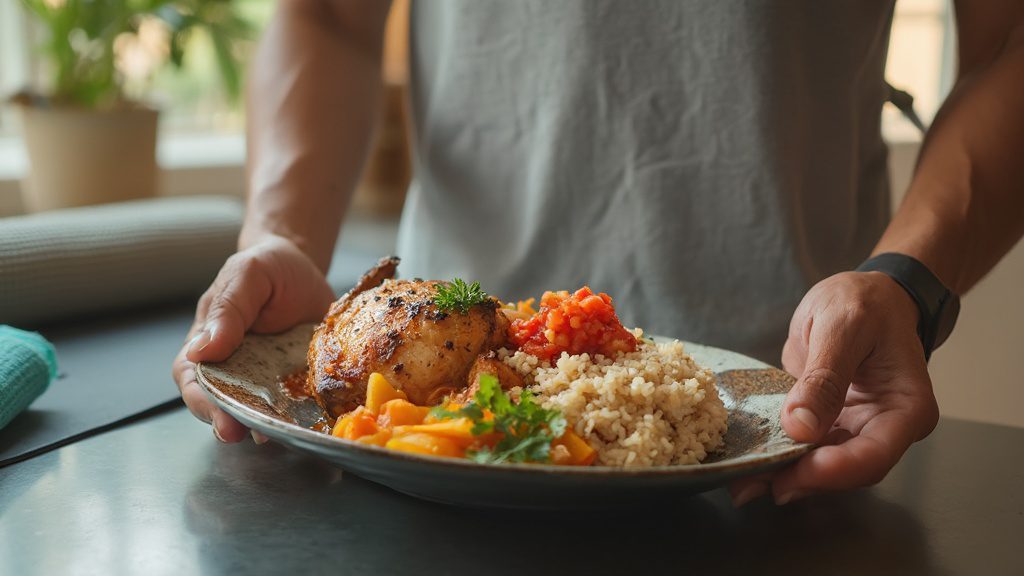
I’ll leave you with what I tell friends who ask me about this over dinner: kimchi is a genuinely useful side dish, not a shortcut. In my own kitchen it earns its spot because it’s low in calories, adds real volume and crunch to a plate, and makes a plain bowl of rice and eggs feel like an actual meal — which is often the difference between sticking with a lighter dinner and reaching for something else an hour later. What it won’t do is burn fat on its own, and any before-and-after story that skips the sodium, the portion, and the rest of the diet is telling you only the flattering half. So my suggestion is a modest one: start with about 50 to 100 grams a day, eat it early in the meal, pair it with protein, and drop one other salty side to keep the balance even. Give it a few weeks and judge it on whether your meals feel more satisfying — not on what the scale says on day three. If you’re managing blood pressure, or spicy and acidic foods tend to bother you, start smaller and talk it through with your own doctor first; that’s a conversation worth having with someone who knows your history. And if you’d like to understand why fermentation does what it does before you commit to the habit, read up on kimchi’s full nutrition and health benefits next. The mechanism is more interesting than the marketing.
Related reading