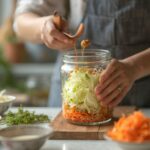
Somewhere between the yogurt aisle and the kombucha fridge, most people trying to eat better for their digestion hit the same wall: every jar claims to be good for the gut, and almost none of them explain why. I grew up eating kimchi at every meal, then spent years in medical training learning which of those old habits research actually backs up. The honest answer is that some fermented foods deliver live bacteria to your gut, some lost theirs on the factory line, and the label rarely tells you which is which. What follows is a ranked look at the ferments worth your money, judged by three things you can check for yourself: whether the live cultures reliably survive, what the research supports, and whether you’d realistically eat it on a Tuesday night. Start with the ranking criteria, and the aisle stops being confusing.
What Fermentation Actually Does to Food — and to Your Gut
Fermentation is controlled microbial digestion that happens before you take a bite. Bacteria or yeast eat the sugars and starches in a food, and in exchange they leave behind acids, gases, new aromas, and — in some cases — a living population of microbes still active in the jar when you open it.
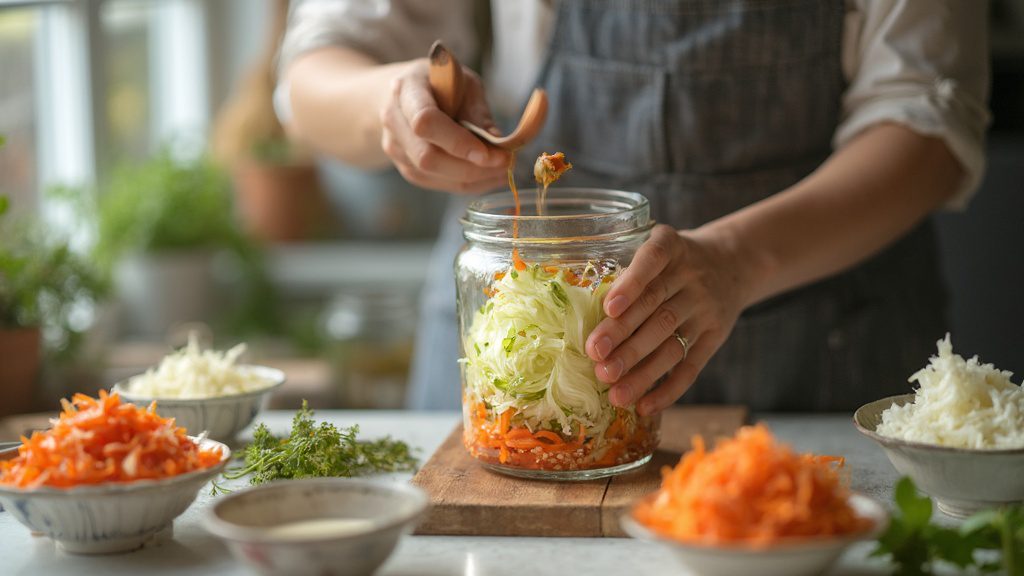
The mechanism is simpler than the marketing suggests. Take napa cabbage for kimchi. You salt it, which pulls water out of the leaves and creates a brine salty enough that spoilage organisms struggle but lactic acid bacteria don’t mind. Those bacteria are already on the cabbage. They start eating the sugars in the leaves and producing lactic acid, which drops the pH. That acidity preserves the cabbage, makes week-three kimchi taste sour in a way week-one kimchi doesn’t, and keeps the wrong microbes from taking over. Nobody has to add a starter culture. In Korean home kitchens, the whole process is just salt, vegetables, seasoning, time, and a cool place to sit.
Two separate things happen along the way, and it’s worth keeping them apart in your head.
The food itself changes. Lactose in milk gets partially broken down, which is why some people who feel lousy after a glass of milk do better with yogurt or kefir. Soybeans in miso, natto, and tempeh get easier to digest, and some antinutrients that bind minerals are reduced. B vitamins can increase. Peptides and compounds that weren’t in the raw ingredient show up. All of this happens whether or not a single live bacterium survives to reach your colon — a jar of pasteurized sauerkraut still has the acids and the transformed cabbage, just not the living cultures.
Living microbes may arrive with the food. This is the part that gets oversold. Your stomach acid and bile are not gentle. A meaningful fraction of the bacteria in a spoonful of raw kimchi or a cup of kefir doesn’t make it past your stomach. Some strains do survive the trip, and even the ones that die aren’t necessarily useless — dead microbial cells and the compounds they made can still interact with your gut lining and immune tissue. But almost none of these organisms take up permanent residence. They pass through. That’s why consistency matters more than any single heroic serving: you’re keeping up a steady stream of visitors, not colonizing a new city.
So what does the research actually support? The strongest human evidence I’d point to is a randomized trial run at Stanford Medicine, published in Cell in 2021, comparing a high-fermented-food diet against a high-fiber diet in healthy adults over ten weeks. According to the Stanford investigators, the fermented-food group showed increased gut microbial diversity and decreased levels of several inflammatory markers, while the high-fiber group didn’t show the same diversity increase over that window. That’s one well-run study in a small group of healthy people, not proof that fermented foods fix anything — and the researchers themselves framed it as an early signal. But it’s a real result from a real trial, and it lines up with what larger observational work has hinted at for years: people who regularly eat fermented foods tend to have more diverse gut microbial communities.
Here’s the honest boundary. Microbiome science is young. We can measure that diversity shifts; we’re much less certain which specific shifts translate into how you feel on a Wednesday afternoon. Anyone selling you a precise mechanism from jar to symptom is out ahead of the evidence.
What that leaves you with is a practical filter rather than a promise. If a fermented food still contains live cultures, you get both the transformed food and the microbial traffic. If it’s been heat-treated, you get the transformed food alone — not worthless, just a different product than the label implies. Sorting the two is most of the work.
Fermented vs. Probiotic vs. Prebiotic: The Distinction Most Articles Skip
Three words get used as if they mean the same thing, and they don’t. Fermented describes how the food was made. Probiotic describes live microbes present in high enough numbers, and specific enough strains, to have a documented effect. Prebiotic describes fiber and compounds that feed the bacteria already living in your colon. A food can be one, two, or all three — and a lot of the confusion in the yogurt aisle comes from assuming the first word guarantees the second.
The International Scientific Association for Probiotics and Prebiotics (ISAPP) drew this line explicitly in its 2021 consensus statement on fermented foods, and it’s the cleanest framework I’ve seen. ISAPP’s position is that fermented foods should be defined by the process — foods made through desired microbial growth and enzymatic conversion — and that most of them do not qualify as probiotic, because “probiotic” requires characterized strains at a dose shown to confer a health benefit. Sauerkraut is fermented. It isn’t a probiotic in the technical sense, even when it’s loaded with live lactic acid bacteria, because nobody has identified which strains are in your particular jar or shown what they do.
That sounds like hair-splitting. It matters for one practical reason: it tells you what to expect. A clinically studied probiotic strain is a targeted tool. A jar of raw kimchi is a general-purpose one — broad microbial exposure plus transformed vegetables plus fiber. Both are reasonable. They’re just not interchangeable, and only one of them comes with a study attached to its specific contents.
Fermented but not probiotic — sourdough, pasteurized sauerkraut, most store pickles
These are the ones that surprise people. Sourdough bread is genuinely fermented — wild yeast and lactobacilli work on the dough for hours — but it goes into a 450°F oven, and nothing living comes out the other side. What you keep is the fermentation’s effect on the bread itself: better mineral availability, slower digestion, a flavor plain commercial white bread can’t produce. Real benefits. Zero live cultures.
Same story with shelf-stable sauerkraut. If it’s sitting unrefrigerated in the middle of the store, it was heat-treated so it wouldn’t keep fermenting in the jar and pop the lid. Beer and wine are fermented and then filtered or pasteurized. Most soy sauce is fermented, then pasteurized. Coffee and chocolate both involve fermentation steps you never think about.
Then there’s the category that isn’t fermented at all: the cucumber pickles most Americans grew up with. Vinegar-brined pickles are acidified, not fermented. No microbe did the work — someone poured acid on cucumbers. They’re fine food. They’re just not doing anything for your gut bacteria. The tell is the ingredient list, which I’ll come back to.
Probiotic-carrying ferments — yogurt, kefir, raw kimchi, raw sauerkraut, natto
These reach you alive, and they’re where the live-culture question actually pays off. Yogurt and kefir are the most reliable, because they’re made with defined starter cultures, kept cold from production to your fridge, and — in the case of US yogurt — often carry the National Yogurt Association’s “Live & Active Cultures” seal, which sets a minimum count at manufacture.
Raw kimchi, raw sauerkraut, and other unpasteurized vegetable ferments carry substantial live populations too, though the strains vary batch to batch. That variability isn’t a flaw so much as the nature of a wild ferment. Natto — Japanese fermented soybeans, sticky and pungent — carries Bacillus subtilis, a spore-forming organism unusually good at surviving stomach acid. Fresh, unpasteurized miso keeps its live cultures as long as you don’t boil it.
Even here, “probiotic” is a stretch by the strict definition. What you can say honestly is that these foods deliver live microbes in meaningful numbers, and that’s the thing the pasteurized versions can’t do.
If you’re wondering whether a capsule would be simpler than any of this, that’s a fair question with a real answer, and I’ve written about fermented foods vs. probiotic supplements separately.
Prebiotic foods that feed what you already have — onion, garlic, oats, legumes
Prebiotics are the half of the equation fermented foods can’t cover, and skipping them is the most common mistake I see. Your resident gut bacteria — the trillions already established, which matter far more than any visitors passing through — run on fermentable fiber. Onions, garlic, leeks, and asparagus supply inulin and fructans. Oats and barley supply beta-glucan. Beans and lentils supply resistant starch and galacto-oligosaccharides. Slightly green bananas and cooled cooked potatoes supply resistant starch too.
This is worth sitting with, because the Stanford trial often gets misread as “fermented foods beat fiber.” That’s not what it showed. The two diets did different things over those ten weeks — the fermented arm shifted diversity, the fiber arm shifted microbial enzyme activity. Two levers, not a winner and a loser.
Traditional Korean eating happens to pull both at once, which I don’t think is a coincidence so much as an accident of what grows and keeps well. A bowl of rice, a few vegetable side dishes, a fermented soybean paste stew, kimchi on the table: fiber and live cultures in the same meal, every meal. You don’t need Korean food to get there. You do need to stop treating a spoonful of kraut as a substitute for vegetables.
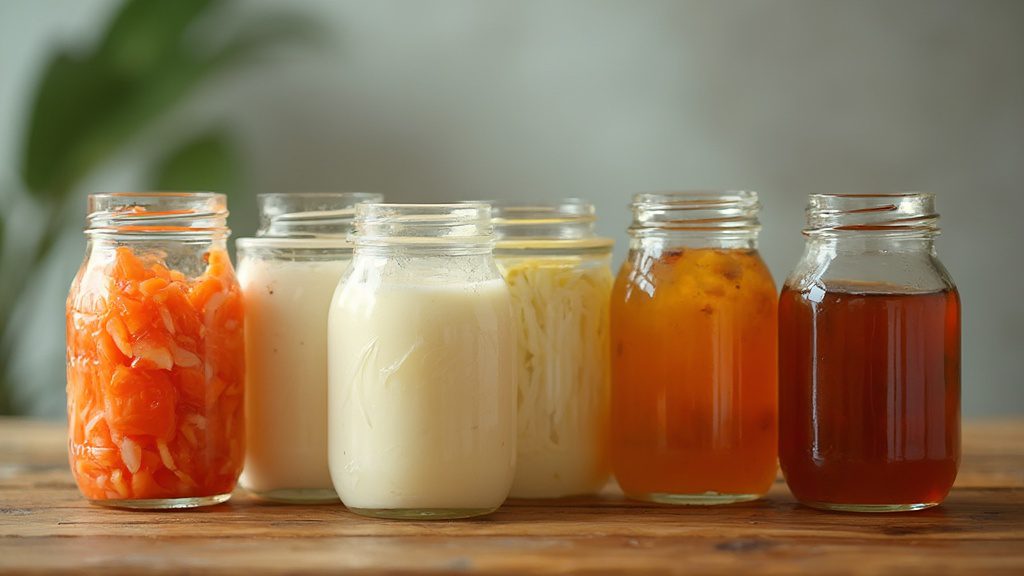
The 9 Best Fermented Foods for Gut Health, Ranked by Live-Culture Reliability
Kefir tops this list, followed by plain yogurt, raw kimchi, and raw sauerkraut — in that order, for reasons that have more to do with manufacturing consistency than with any single nutrient. Three criteria drive the ranking, and I’d rather state them plainly than pretend a list like this is objective. Live-culture reliability: how confident you can be that what you bought still contains living microbes when you eat it. Evidence base: whether human research exists on the food itself, not just the concept. Everyday practicality: whether a normal American household will still be eating it in month three.
One caveat before the list. Ranking these isn’t like ranking painkillers by potency. The gap between number one and number nine is smaller than the gap between eating any of them consistently and eating none of them. If number seven is the one you’ll actually finish, number seven is your best choice.
1. Kefir — the most bacterially diverse option
Kefir is fermented milk made with a starter culture called kefir grains, and it carries more microbial species than any other ferment in a typical American grocery store. Where yogurt is usually two or three defined bacterial strains, kefir typically hosts a dozen or more bacteria plus several yeasts — a small ecosystem rather than a duo. It’s thinner than yogurt, tangy, and slightly fizzy from yeast activity.
Why it ranks first: cold chain from production to shelf, defined cultures, and species diversity no vegetable ferment can match for consistency. It’s also the one I’d suggest to someone who doubts they’ll stick with any of this, because you can drink half a cup in ten seconds.
Buy it plain and unsweetened. Flavored kefir often carries as much added sugar as a soda. One caution: it’s still dairy, and while fermentation reduces lactose considerably, it doesn’t eliminate it — a genuine milk allergy is a milk allergy regardless of culture.
2. Yogurt — but only with “live and active cultures”
Plain yogurt is the most accessible reliable ferment in the US, and the label seal does the verification work for you. The National Yogurt Association’s “Live & Active Cultures” seal indicates a minimum culture count at manufacture, which is more assurance than almost any other fermented product on the shelf offers.
Human research on yogurt runs deeper than on anything else here, largely because it’s been studied for decades in populations that already eat it. Greek yogurt, Icelandic skyr, and Australian-style yogurt are all fine — strained versions concentrate protein.
One caution: heat-treated yogurt exists, sold specifically because it’s shelf-stable, and it has no live cultures. Check the sugar line too. A single cup of fruit-on-the-bottom yogurt can carry 20+ grams of added sugar, which is a strange way to pursue gut health.
3. Kimchi — fiber plus live lactobacilli in one dish
Kimchi is the only entry that delivers meaningful vegetable fiber and live cultures in the same forkful, which is why I rank it above sauerkraut despite similar microbiology. A traditional baechu-kimchi is napa cabbage, Korean radish, scallion, garlic, ginger, gochugaru (Korean red pepper flakes), and salted seafood or a vegan substitute. You’re eating vegetables that happen to be alive.
An honest note from someone who grew up with it: the kimchi in most American refrigerator cases is younger and milder than what my family kept in a separate kimchi fridge. Older kimchi is more sour, more complex, and by most measures more active. If a jar tastes sharp and fizzes slightly when you open it, that’s not spoilage — that’s a working ferment.
One caution: sodium. Kimchi is salt-preserved, and the numbers add up faster than people expect. There’s more on kimchi’s specific gut benefits if you want to go deeper on this one food.
4. Raw sauerkraut — the cheapest entry point
Raw sauerkraut is cabbage and salt, and it costs almost nothing to make at home. Nutritionally it’s simpler than kimchi — no aromatics, no pepper — but the live lactic acid bacteria are the same family, and the fiber is real.
It ranks below kimchi mostly on flavor variety. Plain kraut gets monotonous. It’s also the easiest ferment to get wrong at the store, because the pasteurized version sits three feet from the raw version and looks identical. Refrigerated case, “raw” or “unpasteurized” on the label, cloudy brine.
One caution: same sodium issue as kimchi. If you’d rather control the salt yourself, how to make sauerkraut at home in 5 days is genuinely a two-ingredient project.
5. Miso — use it without boiling it
Miso is fermented soybean paste, and it’s the ferment most Americans already own and unknowingly kill. Unpasteurized miso contains live cultures; boiling water does not. Stir it into soup after you’ve taken the pot off the heat, or whisk it into dressings and marinades.
It lands mid-list because live-culture status depends entirely on which tub you bought — refrigerated, unpasteurized miso is alive, shelf-stable often isn’t — and because even in the best case, a serving is a tablespoon. One caution: miso is very high in sodium per spoonful.
6. Natto — the highest tolerance barrier, unusual survival
Natto is fermented whole soybeans, and its bacterium is the best survivor on this list. Bacillus subtilis forms spores, so it passes through stomach acid far more intact than most lactic acid bacteria. Natto is also a notable dietary source of vitamin K2 in the MK-7 form.
So why sixth? Because it’s sticky, stringy, ammoniac, and most Americans who try it once don’t try it twice. Practicality is a real criterion, not a courtesy one. If you’re in the minority who likes it, move it up to number two on your own list.
7. Tempeh — the ferment you can cook
Tempeh is fermented soybeans pressed into a firm cake, and it’s the only entry here that survives a hot pan as a food even though its cultures don’t. Cooking kills the Rhizopus mold that made it, so you get the fermentation’s effects on the beans — better digestibility, more available minerals, complete protein — without live microbes.
It’s on the list because those food-transformation benefits are real and because tempeh does something no other ferment here does: it works as a main protein. One caution: don’t count it toward your live-culture intake.
8. Kombucha — read the sugar label first
Kombucha is fermented sweetened tea. It does contain live bacteria and yeast, and it is not the equal of kefir despite similar marketing. Culture counts and species diversity in commercial kombucha vary enormously between brands and batches, and the drink is thin on the food-transformation side — there’s not much substrate in tea to transform.
It ranks eighth because the variability is high and the payload is modest, not because it’s useless. As a swap for soda, it’s a clear improvement. One caution: check the sugar, which can run 10–15 grams per bottle in commercial versions, and skip it if you’re avoiding alcohol entirely — trace ethanol is a normal fermentation byproduct.
9. Traditional cheeses and skyr — the ones people forget
Aged cheeses like gouda, cheddar, gruyère, and Swiss are fermented, and some retain live bacteria from their starter cultures, particularly raw-milk and traditionally made versions. Cottage cheese with live cultures counts too, and Icelandic skyr sits somewhere between strained yogurt and cheese.
Last place is about uncertainty, not quality. Cheese is fermented food nobody labels for culture content, so you’re guessing. One caution: processed cheese slices and most pre-shredded products aren’t in this category, and pregnant people are generally advised to avoid unpasteurized soft cheeses.
How to Tell a Real Ferment from a Pickled Impostor at the Store
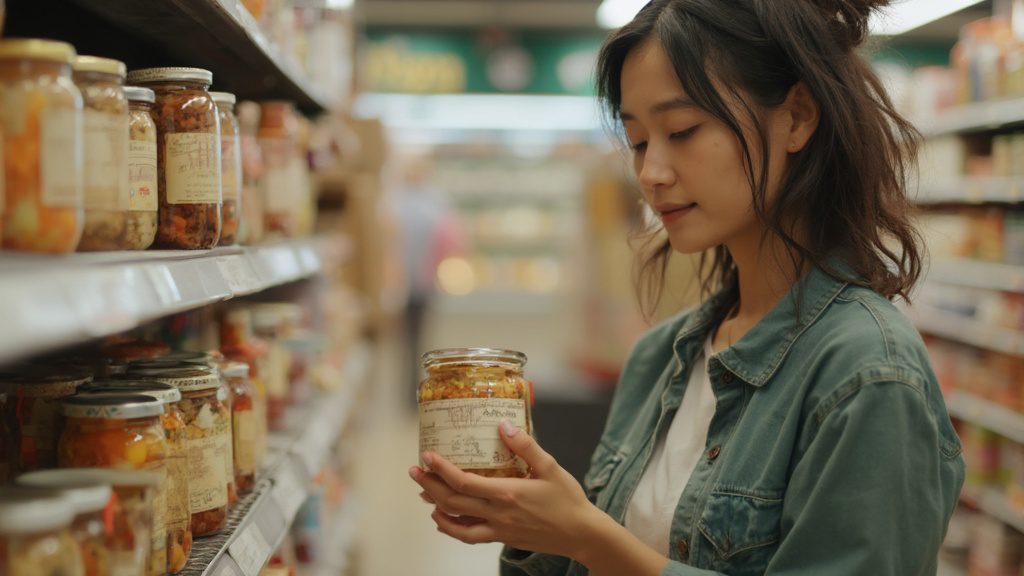
Four checks, in order, and you’ll be right almost every time: it’s in the refrigerated case, the label says raw or unpasteurized, vinegar isn’t the second ingredient, and the brine looks cloudy rather than crystal clear. Any one of those failing isn’t automatically disqualifying. Three of four failing means you’re holding a jar of acidified vegetables.
Here they are in the order you’d actually run into them pushing a cart.
Check the aisle before you check the label. Live cultures keep working at room temperature. That means gas, pressure, and eventually a jar that leaks or a lid that bulges — which no manufacturer wants on a shelf for eighteen months. So the shelf-stable version got heat-treated. Almost without exception, if a fermented vegetable product is sitting in the center aisles next to the canned goods, its cultures are gone. The refrigerated case is where the living products have to live. This one check eliminates most of the confusion, and it takes zero reading.
Then look for “raw,” “unpasteurized,” or “live cultures.” Manufacturers who went to the trouble of keeping their product alive will tell you, because it’s the expensive way to make food. What you won’t usually find is a number. A yogurt might carry the Live & Active Cultures seal, but a jar of kimchi almost never states a colony count — and honestly, a count on a wild vegetable ferment would be a snapshot of one batch on one day anyway. Missing the word “raw” is a soft negative; some small producers just don’t print it. Seeing “pasteurized” is a hard one.
Read the first three ingredients. A real vegetable ferment reads like a shopping list: cabbage, water, salt. Maybe garlic, ginger, gochugaru. What you’re looking for is what isn’t there — vinegar. If distilled vinegar or acetic acid shows up near the top, the sourness was poured in rather than produced by bacteria. That’s the whole distinction between a pickle and a ferment, and it’s why the dill spears in most American refrigerator doors don’t count despite being cold and crunchy. Sugar high on the list is another flag, particularly in kombucha and flavored kefir.
Look at the jar itself. Living ferments look alive. The brine is cloudy or slightly milky from suspended bacteria. There may be small bubbles clinging to the glass or rising when you tilt it. Sometimes the lid gives a faint hiss when you open it at home — that’s carbon dioxide, and it’s a good sign, not spoilage. Crystal-clear brine with vividly uniform color usually means pasteurized, filtered, or vinegar-based.
What “contains probiotics” on a label actually means
Legally, less than you’d hope. The FDA doesn’t define “probiotic” as a labeling term for conventional foods, and it doesn’t require culture counts on food labels. What the FDA does regulate is the claim: under its guidance on structure/function claims and its labeling regulations, a food or supplement can say it “supports digestive health” but can’t say it treats, prevents, or cures a condition without going through drug approval. The FTC applies a parallel standard through its Health Products Compliance Guidance, requiring that health claims be substantiated by competent and reliable scientific evidence.
The practical translation: “contains probiotics” tells you the manufacturer added something. It doesn’t tell you which strains, how many, or whether any survived to the date on the lid. “Supports gut health” is a permitted marketing phrase, not a finding. And if a jar of anything claims to fix bloating, IBS, or “leak,” that’s a company operating past what the evidence and the regulations allow — which tells you something about the rest of their claims too.
The one place counts are somewhat dependable is dairy. The National Yogurt Association seal sets a minimum at manufacture, and some kefir and yogurt brands voluntarily print CFU counts. Treat those as manufacture-date numbers, not eat-date numbers. Live cultures decline over shelf life, which is a real argument for grabbing the container with the furthest-out date rather than the one at the front.
The specific traps I see most
Shelf-stable “probiotic” pickles. Some products add heat-tolerant Bacillus spores back after processing so they can make a probiotic claim on a shelf-stable product. Not fraudulent, but it’s a different thing from a live vegetable ferment — one added organism versus a mixed community.
Kimchi in the international aisle, unrefrigerated. Usually pasteurized for export. The refrigerated kimchi at a Korean grocery, or in the produce section’s cold case, is the living version. Cheaper too, generally.
“Pickled” on a Korean or Japanese label. Korean jangajji and some Japanese tsukemono are soy-and-vinegar preserved, not lactic-fermented. Delicious, not the same category.
Freshly opened vs. three-weeks-open. Once opened, keep it cold and keep the vegetables under the brine. Exposed to air, the surface can grow kahm yeast — a wrinkly white film that’s harmless but off-tasting — or actual mold, which is fuzzy and colored and means the jar goes in the trash.
If all of this label-squinting feels like more work than it’s worth, that’s a fair conclusion, and it’s exactly why I keep pointing people toward making one thing themselves. How to make sauerkraut at home in 5 days takes cabbage, salt, and a jar — and you never have to wonder whether it’s alive, because you’ll watch it bubble.

What I Tell Patients in My Own Clinic: Start Small, One Food, Two Weeks
One food. One tablespoon. Once a day. Two weeks before you add anything else. That’s the whole protocol I give people, and it’s deliberately unimpressive, because the failures I see almost never come from choosing the wrong ferment — they come from starting with six of them at once.
The pattern is so consistent I can predict it. Someone reads an article like this one, gets motivated, and comes home from the store with kefir, kombucha, two kinds of kraut, a tub of miso, and a jar of kimchi. Day one they have all of it. Day two they’re bloated and gassy. Day three they feel worse than before they started, decide fermented foods “don’t agree with them,” and the jars sit in the fridge until they get thrown out. Sixty dollars and a conclusion that isn’t true.
Here’s what actually happened: they went from near-zero fermented food to a large, mixed microbial load overnight, and their gut responded the way any system responds to an abrupt change in input. Gas in the first week is usually adaptation. Your resident bacteria are meeting new arrivals and new substrate, and the fermentation byproducts — gas included — go up before things settle. That’s not a diagnosis of anything. It’s a plumbing situation.
So I have people isolate one variable. Pick the ferment you’re most likely to keep eating, not the one that ranked highest on somebody’s list. A tablespoon of kimchi with dinner, or half a cup of plain kefir with breakfast. Same food, same amount, same time of day, for two weeks. Then, if you want, add a second one and give it another two weeks.
Why two weeks and not three days? Two reasons. Most of the initial adjustment settles in the first seven to ten days, so a shorter trial tells you about your adaptation period rather than about the food. And two weeks is long enough to notice a pattern but short enough that people actually finish it. I’ve watched a lot of “30-day challenges” die on day five.
When the gas isn’t just adaptation. I want to be clear about the line here, because “push through it” is bad advice past a certain point. Adaptation looks like more gas and mild bloating, mostly in the first week, gradually easing, no other symptoms, and you feel fine otherwise. What doesn’t fit that pattern — symptoms that get worse over two weeks instead of better, significant pain, diarrhea, flushing or headaches after eating, or any reaction that feels systemic rather than digestive — isn’t something to power through. Stop the food and talk to your own clinician about what’s driving it. Fermented foods are food, not therapy, and no jar of cabbage is worth two weeks of feeling terrible.
The other mistake: treating the tablespoon as the ceiling. A tablespoon is a starting amount, not a target. Once you’re comfortable, a normal serving of kimchi is more like a quarter to a half cup, and a serving of kefir is a cup. In Korea nobody measures kimchi; it’s just on the table at every meal, and you take what you take. The small start is training wheels, not the destination.
What I don’t promise anyone. I can’t tell you your bloating will improve, because the research doesn’t support that kind of specificity and because I don’t know what’s causing it. What I can tell you is that regular fermented-food intake is associated with greater gut microbial diversity in the studies we have, that the foods themselves are nutritious independent of any microbiome effect, and that the downside risk of a daily tablespoon of kimchi is very low for most healthy adults. That’s a reasonable bet. It’s not a treatment plan.
Consistency over intensity. If I could get one idea across, it’s this. Because these microbes pass through rather than settle in, three tablespoons on Sunday does less than one tablespoon Monday through Wednesday. The people who see something change are the ones for whom a ferment became boring — just a thing that’s on the plate, the way kimchi was in my grandmother’s kitchen and now mine. Nobody there thought of it as a health intervention. It was lunch.
How Much Per Day, and When: A Realistic Weekly Plan
One to three servings a day is roughly where the available human research clusters, and there’s no official number to point to. In the Stanford trial, the fermented-food arm worked up to about six servings daily — a deliberately high experimental amount, not a recommendation for anyone’s kitchen. For everyday eating, one serving a day of something live is a reasonable floor, two or three is a comfortable target, and beyond that you’re mostly adding sodium. That’s the honest state of it: a range, not a prescription.
A serving, roughly: half a cup of kefir or yogurt, a quarter cup of kimchi or kraut, a tablespoon of miso, one cup of kombucha.
The plan below maps onto meals you already eat. Nothing here requires a new recipe.
Week 1 — one food, one small serving
Pick one. Put it somewhere in your day that already exists.
| Days | What | Where it goes |
|---|---|---|
| 1–3 | 1 Tbsp kimchi or ¼ cup kefir | With dinner, or into your morning routine |
| 4–7 | Double it — 2 Tbsp kimchi or ½ cup kefir | Same slot, same time |
That’s the entire first week. The ramp exists so you can tell the difference between “this food doesn’t work for me” and “I went too fast.”
Three placements that require no cooking: kimchi chopped over scrambled eggs, kefir poured over cereal or blended with a banana, a spoonful of kraut alongside whatever protein is on the plate. In Korean home cooking, kimchi isn’t an ingredient you build a meal around — it’s just there, in a small dish, next to everything else. That’s the model to copy.
Week 2–4 — two or three ferments across the day
Once week one is uneventful, spread it out rather than piling it on.
| Meal | Option |
|---|---|
| Breakfast | ½–1 cup plain kefir or yogurt |
| Lunch | ¼ cup kimchi or kraut on the side |
| Dinner | Miso whisked into broth off the heat, or a second small kimchi serving |
Three small placements beat one large one, for a reason worth stating plainly: since these microbes are transient rather than resident, steady arrival across the day is more useful than one big dose. This is also where the sodium math starts to matter. A quarter cup of kimchi plus a tablespoon of miso can run several hundred milligrams of sodium. The American Heart Association recommends no more than 2,300 mg of sodium per day for adults, with an ideal limit closer to 1,500 mg for most, so keep vegetable ferments as side dishes rather than a main volume food — and if you’re already watching salt, weight the plan toward kefir and yogurt, which are the low-sodium ferments.
Kombucha and tempeh slot in as substitutions, not additions. Kombucha replaces an afternoon soda. Tempeh replaces a dinner protein.
Timing questions: with meals, empty stomach, or before bed
With food, most of the time. The reasoning is straightforward: a meal buffers stomach acid, which gives more live organisms a chance at surviving the trip. There’s no strong human trial showing that a fermented food eaten with lunch outperforms the same food eaten at 3 p.m., so treat this as sensible physiology rather than proven advantage. If mid-afternoon is when you’ll actually drink the kefir, drink it then.
Empty stomach isn’t a rule, and probably isn’t better. You’ll see the claim made both ways online. Neither direction has good evidence behind it. Don’t reorganize your day for it.
Before bed is fine, with one caveat. Some people find that dairy or fermented vegetables close to bedtime makes reflux worse. If that’s you, move it earlier. That’s individual, not general.
One timing point that does hold up: don’t cook your live ferments. Kimchi in a hot stew, miso in boiling water, sauerkraut simmered on a bratwurst — all delicious, all dead. Korean cooking does this constantly with older, sourer kimchi, and it’s genuinely good food. Just count it as a vegetable dish, not as your live-culture serving for the day.
On antibiotics: if you’re taking a course, spacing fermented foods a couple of hours from the dose is a common suggestion, but the evidence is thin, and this is a good thing to ask your prescribing clinician about rather than a rule to apply on your own.
Who Should Be Cautious, and the Real Risks
Four groups have a genuine reason to slow down before adding fermented foods: people managing blood pressure or kidney disease, people who react to histamine-rich foods, people who are immunocompromised, and people who are pregnant. For everyone else, the honest risk profile of a daily serving of kimchi or kefir is low — closer to “eating cheese” than to “starting a medication.” But low isn’t zero, and the specifics matter more than the reassurance.
Sodium is the risk most people underestimate. It’s the most concrete downside on the list. Vegetable ferments are salt-preserved by definition, and salt is what keeps the wrong microbes out. A single serving of kimchi or sauerkraut can carry a few hundred milligrams of sodium, and miso runs higher per spoonful. Against the American Heart Association’s 2,300 mg daily ceiling — and its 1,500 mg ideal for most adults — three generous servings of vegetable ferment can eat up a meaningful share of your day’s budget before you’ve salted anything else.
Two things follow. If you have hypertension, heart failure, or kidney disease, treat vegetable ferments as a salted condiment and bring the actual amounts to your own clinician rather than guessing. And if you want the live cultures without the salt, kefir and plain yogurt are the low-sodium options here — a real advantage they hold over kimchi that nobody mentions.
I’ll also name something the Korean epidemiology literature has wrestled with for decades: high intake of salt-preserved foods has been examined in relation to gastric cancer risk in Korea and Japan, and the picture involves salt, H. pylori infection, and overall dietary pattern rather than fermentation itself. It’s an active research area, not a settled verdict, and the practical takeaway is unglamorous — moderate the salt, don’t fear the ferment.
Histamine sensitivity. Fermentation increases histamine and other biogenic amines in food. Most people process them without incident. Some don’t, and for them the reaction pattern looks different from ordinary gas: flushing, headache, hives, nasal congestion, or a racing heart within an hour or two of eating aged cheese, kimchi, kombucha, or wine. Older, sourer ferments carry more than young ones — which is why the mild, week-old kimchi in an American grocery case may sit better with a sensitive person than the aggressively sour jar I’d personally reach for.
If that pattern sounds familiar, it’s worth looking into properly rather than experimenting on yourself. Same for anyone who’s been told they have SIBO (small intestinal bacterial overgrowth), where the question of whether added live cultures help or aggravate is genuinely unresolved. There’s more in fermented foods, histamine intolerance and SIBO.
Immunocompromise. This is the one place I’d say be actively conservative. People on immunosuppressive medication, in cancer treatment, with advanced liver disease, or with central venous catheters are in a different risk category. Case reports exist of bacteremia and fungemia traced to probiotic organisms in severely immunocompromised patients — rare, but documented, and enough that professional societies advise caution rather than enthusiasm. Live unpasteurized products are the concern; pasteurized fermented foods carry no such issue. If you’re in this group, this is a conversation with your treating physician, not a decision to make from a blog post.
Pregnancy. The general guidance is straightforward and worth following. The FDA and CDC advise pregnant people to avoid unpasteurized dairy and unpasteurized soft cheeses because of Listeria risk. Commercially produced pasteurized yogurt and kefir are fine. Properly fermented vegetables like kimchi and sauerkraut are generally considered acceptable when they’re commercially made and refrigerated, but homemade versions with unknown handling are a reasonable thing to skip for nine months. Ask your OB about your own situation rather than triangulating from internet consensus.
Home fermentation: what actually goes wrong
Home fermenting vegetables is one of the safer preservation methods there is, and the reason is chemistry rather than luck. Lactic acid bacteria drop the pH quickly, and Clostridium botulinum can’t produce toxin in a properly acidified environment. According to the National Center for Home Food Preservation at the University of Georgia, correctly fermented vegetables reach a pH low enough to be shelf-stable when canned, and the failure modes are almost always deviations from the basic method.
The deviations that matter:
Not enough salt. The NCHFP’s tested sauerkraut method calls for a specific ratio — roughly 3 tablespoons of canning or pickling salt per 5 pounds of shredded cabbage — and cutting the salt to make it “healthier” is how people end up with mush and off-smells instead of kraut. Use their ratio. Adjust your intake, not the recipe.
Vegetables above the brine. Everything has to stay submerged. Exposed surfaces are where mold and kahm yeast start. A weight, a folded cabbage leaf, or a brine-filled bag on top solves it.
Confusing kahm yeast with mold. Kahm yeast is a flat, wrinkly, off-white film — harmless, skim it off, and expect a slightly musty flavor. Mold is fuzzy and colored: green, black, pink, blue. Fuzzy means discard the batch, not scrape and continue.
Trusting your nose alone. A working ferment smells sour and sharp. What it shouldn’t smell like is rotten, putrid, or like nothing at all. Slimy texture with a foul smell means throw it out. In my family’s kitchen the rule was simpler than any pH strip: if it smells wrong, it is wrong.
Temperature. Cool room temperature, roughly 65–72°F, gives a slow clean ferment. Hot kitchens ferment fast and go soft. Korean households traditionally solved this with buried onggi crocks and now with dedicated kimchi refrigerators that hold a steady cold temperature — the point being consistency, not any magic in the vessel.
The reason I keep recommending home fermentation despite listing all of this: you control the salt, you see the process, and you never have to interrogate a label again.
Frequently Asked Questions
How long until fermented foods change how my gut feels?
Most people notice a difference in gas and bowel regularity within one to two weeks, and measurable microbiome shifts in research settings have shown up over several weeks. In the Stanford trial, changes in microbial diversity were tracked across a ten-week window — so if you’re expecting something in three days, recalibrate. What you’ll notice early is adaptation, not benefit. If nothing has changed after a month of consistent daily intake, that’s useful information too: fermented foods are worth eating for their nutrition regardless, but they’re not the lever for whatever’s bothering you, and that’s worth raising with your own clinician.
Is kombucha as effective as kefir or yogurt?
No, and I’d rank it well below both. Kefir and yogurt are made with defined starter cultures, held cold through the whole supply chain, and often carry a culture-count assurance on the label. Kombucha’s live content varies widely between brands and batches, and tea offers very little substrate for fermentation to transform, so the food-side benefit is thin. As a replacement for soda it’s a straightforward improvement. As your only fermented food, it’s the weakest choice on the list. If you like it, keep it — just don’t let it be the whole plan.
Can I get the same benefit from a probiotic supplement instead?
Not the same benefit — a different one. A supplement gives you specific, characterized strains at a known dose, which is what “probiotic” technically requires; a fermented food gives you a broad mixed community plus the transformed food itself, including fiber in the case of kimchi and kraut. Neither substitutes for the other, and for general wellness in a healthy adult I’d start with food, because you’re also eating something nutritious. If you’re considering a supplement for a specific reason, that’s a conversation worth having with a clinician who knows your history. The trade-offs are laid out in detail in fermented foods vs. probiotic supplements.
Does cooking kimchi or miso kill the good bacteria?
Yes. Heat kills live cultures, and it doesn’t take much — well below boiling is enough. Kimchi jjigae, kimchi fried rice, and miso soup made with actively boiling water are all excellent food with no live cultures left in them. What survives cooking is everything fermentation did to the ingredients: the acids, the softened fiber, the flavor compounds, the improved mineral availability. So keep cooking with your older, sourer kimchi — that’s exactly what Korean home cooks do with it — and just count that dish as a vegetable side rather than your live-culture serving. Put a spoonful of raw kimchi on the table separately if you want both. For miso, whisk it in after the pot comes off the heat.
What’s the single best fermented food to start with?
Plain kefir, if you tolerate dairy — highest culture diversity, most reliable manufacturing, and it takes ten seconds to drink. If dairy is out, raw kimchi, because you get fiber and live cultures in the same bite and it makes ordinary food taste better. Either way: one food, small serving, two weeks. If you’d rather skip the label-reading entirely, how to make sauerkraut at home in 5 days needs two ingredients and a jar, and you’ll never wonder whether it’s alive.

If I had to compress all of this into one thought, it would be this: the best fermented foods for gut health are the ones with live cultures you can actually verify and a taste you’ll actually come back to. Kefir and plain yogurt are the easiest places to start, raw kimchi and raw sauerkraut give you fiber alongside the bacteria, and miso stirred in off the heat costs you almost nothing in effort. I’ve watched far more people quit because they bought six jars in one trip than because any single food disagreed with them — so pick one, keep the serving small, and give it two weeks before you judge it. If you have kidney or blood pressure concerns, take immunosuppressive medication, are pregnant, or have a history of reacting to aged and fermented foods, bring this up with your own clinician before you change much; a short conversation is worth more than any list, including mine. When you’re ready for the next step, the sauerkraut and kimchi how-tos are where I’d send you — a jar you fermented yourself tells you more about live cultures than any label ever will.
함께 보면 좋은 글
- how to make sauerkraut at home in 5 days
- kimchi’s specific gut benefits
- fermented foods vs. probiotic supplements
- fermented foods, histamine intolerance and SIBO