Some Korean home cooks call it “the side dish that outlives the meal,” and the internet has decided it’s everything from a weight-loss trick to a hormone reset. Sorting that out matters more if you’re a woman deciding whether a salty, spicy fermented cabbage actually earns a spot in your daily routine — especially with a sensitive stomach, a reflux history, or a pregnancy in the picture. What follows separates the claims backed by human trials from the ones still sitting in petri dishes and mouse studies, so you can judge each benefit by the strength of its evidence rather than the confidence of the headline. There’s also the part most lists skip: how much sodium a real serving carries, who tends to bloat at first, and where a reasonable starting amount lands.
What Kimchi Actually Is (and Why Fermentation Matters for Women)
Kimchi is salted, seasoned vegetables left to ferment with the bacteria already living on them — and that fermentation step, not the cabbage itself, is what most of the health research is actually about. A fresh cabbage salad with chili on it and a jar of properly soured kimchi are not the same food, biologically speaking.
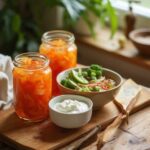
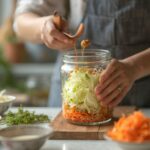
Here’s the process, plainly. Napa cabbage gets salted for several hours, which pulls water out and creates an environment where most spoilage microbes can’t survive. Then it’s rinsed and coated with a paste — gochugaru (Korean red pepper flakes), garlic, ginger, scallion, and usually a small amount of fish sauce or salted shrimp. Packed into a container and left at room temperature, the lactic acid bacteria native to the vegetables take over. Within a few days they’ve eaten through the available sugars and produced lactic acid, which is why kimchi smells sharp and tastes sour rather than just salty. In the fridge that process slows to a crawl and continues for months. Lactobacillus and related species dominate as it matures — which is why kimchi gets grouped with yogurt, kefir, and sauerkraut in the fermented-food literature rather than with pickles made in vinegar.
That last point matters more than it sounds. Vinegar pickles are preserved by acid added from outside; nothing in them is alive. Kimchi generates its own acid, from its own live bacteria, and those bacteria are still there when you eat it — provided the jar hasn’t been pasteurized. Shelf-stable, heat-treated kimchi sold at room temperature in the center aisles has had the microbes killed off for stability. If live cultures are the reason you’re buying it, look in the refrigerated section, and look for a product that tastes sour rather than fresh.
So why does any of this land differently for women? Two reasons worth naming without overselling either. First, the research on fermented foods and the gut microbiome — most notably a 2021 Stanford trial in Cell that put adults on a high-fermented-food diet for ten weeks — found increases in microbiome diversity and decreases in inflammatory markers. That study included both men and women and didn’t isolate sex differences, so the honest read is: this is a general finding, not a women’s finding. Second, and more specific: women report functional GI issues like IBS and chronic constipation at meaningfully higher rates than men, and gut symptoms in many women shift across the menstrual cycle. That doesn’t mean kimchi fixes any of it. It means the organ system fermented foods act on is one where women are more likely to be having trouble in the first place, which is a reasonable basis for interest — and a very different statement from “kimchi balances your hormones.”
The other side of the ledger deserves equal billing, because it’s where kimchi’s specifics actually differ from yogurt. Kimchi is a salt-preserved food. The sodium isn’t incidental; it’s the mechanism. That has real implications for anyone tracking blood pressure, anyone pregnant, and anyone who’s been told to watch sodium for another reason — and it’s the number that gets left out of nearly every benefits list you’ll read.
One more thing worth setting straight up front: the fish sauce and salted shrimp in traditional kimchi mean most store-bought jars aren’t vegetarian. Vegan versions exist and ferment fine, though the flavor lands a little cleaner and less savory. If you keep kosher, are pregnant and avoiding raw seafood products, or are cooking for someone with a shellfish allergy, read the label rather than assuming — the ingredient is usually listed as jeotgal, anchovy sauce, or salted shrimp, and it’s easy to skim past.
The 5 Benefits With the Strongest Evidence for Women
Five claims about kimchi hold up better than the rest — and none of them are the ones on the viral infographics. What follows is ranked by how strong the human evidence actually is, starting with the best-supported and ending with one that’s promising but still preliminary. Notice how the language tightens as you go down the list: that’s not hedging for its own sake, it’s what the data supports.
1. Fermented foods increase gut microbiome diversity. This is the strongest one, and it comes from an actual randomized trial in humans. The 2021 Stanford study published in Cell assigned adults to either a high-fiber or a high-fermented-food diet for ten weeks. The fermented-food group — eating roughly six servings a day of things like yogurt, kefir, kimchi, and kombucha — showed increased microbiome diversity and lower levels of several inflammatory markers. The fiber group didn’t. That’s a real, measured effect from a controlled trial, which puts it in a different category from everything else on this list. Two caveats keep it honest: the trial used a variety of fermented foods, not kimchi alone, and six servings a day is far more than most people eat. Diversity is also a marker researchers associate with gut health, not a health outcome in itself. You can’t feel it. You won’t notice it. It’s a plausible foundation for other benefits rather than a benefit you experience.
2. Regular fermented-food intake is associated with less constipation. Women report chronic constipation at roughly two to three times the rate men do, which makes this the benefit most likely to matter in daily life. Trials of specific Lactobacillus strains have shown modest improvements in stool frequency and transit time, and kimchi’s fiber content — a cup of napa cabbage kimchi carries a couple of grams — contributes independently of the bacteria. What the evidence doesn’t support is treating kimchi as a laxative. The effect sizes in these studies are small, they vary by strain, and most were run with supplements rather than food. A reasonable expectation: a small nudge in the right direction over weeks, not a fix.
3. Kimchi is nutrient-dense for its calorie count, including vitamin K and folate. Straightforward food-composition fact, no trial required. Napa cabbage, scallion, and Korean radish bring vitamin K, vitamin C, folate, and a range of carotenoids, and fermentation appears to increase the bioavailability of some B vitamins. For women, folate is worth naming specifically — it matters before and during pregnancy, and most people don’t get enough from vegetables alone. Kimchi is not a folate source you should rely on for that purpose; prenatal supplementation exists for a reason. But as vegetables you’ll actually eat, it earns its place, and a half-cup serving lands under 25 calories.
4. Kimchi consumption is associated with lower obesity risk in Korean population studies. Here the evidence gets softer, and it’s worth understanding why. Large observational studies in Korea have found associations between moderate kimchi intake and lower rates of obesity and metabolic syndrome. Observational means researchers watched what people ate and tracked outcomes — they didn’t assign diets. People who eat a lot of kimchi in Korea are usually eating a traditional diet overall: more vegetables, more home cooking, less ultra-processed food. Untangling kimchi from that pattern is genuinely hard. And notably, the same studies often show the association reverse at very high intakes, likely because of sodium. The honest read: kimchi fits well into an eating pattern associated with healthier weight. It isn’t a weight-loss food, and no trial has shown it causes weight loss.
5. Anti-inflammatory and estrogen-related effects — real research, early stage. This is the one that gets the most breathless coverage and deserves the most caution. Some kimchi-derived Lactobacillus strains have shown anti-inflammatory activity in lab and animal studies. Certain compounds in cruciferous vegetables, including the napa cabbage kimchi is made from, are studied for how they interact with estrogen metabolism. That research exists and it’s legitimate. What doesn’t exist is a human trial showing kimchi changes hormone levels, eases menopausal symptoms, or affects breast cancer risk in any measurable way. When you see “kimchi balances hormones,” this is the evidence being stretched to make that headline — a cell-culture finding wearing a clinical costume. Interesting to watch. Not something to act on.
The pattern across all five: kimchi is a genuinely good vegetable with live bacteria and real nutritional value, supported by decent evidence for gut effects and thinner evidence for everything else. That’s a good food. It’s not a supplement, and the difference is where most of the confusion lives.
Hormones, Periods, Pregnancy: Separating Evidence From Hype
No human trial has shown that kimchi changes hormone levels, shortens periods, eases cramps, or shifts menopausal symptoms. That’s the direct answer, and it’s worth stating plainly, because this is the corner of the internet where kimchi gets the most confident treatment and has the least behind it.
Start with the claim you’ve probably seen: kimchi “balances your hormones.” Trace it back and it usually lands on one of two things. Either the estrogen-metabolism research on cruciferous vegetables, or the “estrobolome” — the collection of gut bacteria that produce beta-glucuronidase, an enzyme involved in how the body recirculates estrogen. Both are real areas of study. Neither has produced a trial where people ate kimchi and their hormone panels moved. The gap between “gut bacteria participate in estrogen metabolism” and “eat this cabbage to fix your hormones” is several decades of research nobody has done yet. Cruciferous vegetables are good for you for ordinary reasons. That’s the claim I’d stand behind.
Cycle-related symptoms are a subtler case, and here I’d say the mechanism is at least plausible even though the direct evidence isn’t there. Many women notice their digestion changes in the days before and during their period — looser stools, more bloating, more cramping. That’s largely prostaglandins acting on the gut, not a microbiome problem. If a fermented food is helping your baseline gut function over months, it’s reasonable that the week feels marginally less rough. But that’s inference, not a finding. Nobody has run the trial. If someone tells you kimchi fixes PMS, they’re describing a hope.
Pregnancy is different, because here there’s something concrete to say. There’s no evidence that properly made kimchi is unsafe in pregnancy, and it’s a normal part of the diet across Korea, including for pregnant women. Three practical things do change, though.
Sodium. A cup of kimchi can carry 600 to 900 milligrams depending on the brand, and blood pressure gets watched closely in pregnancy. This isn’t a reason to avoid kimchi — it’s a reason to count it as part of your day’s sodium rather than as a free vegetable.
Fish sauce and salted shrimp. Jeotgal is fermented, not raw in the sushi sense, and it’s mixed into a fermenting product. Most obstetricians don’t flag it. But if you’ve been told to avoid uncooked seafood products, this is a specific thing to ask about rather than guess at, and vegan kimchi sidesteps the question entirely.
Listeria and unpasteurized foods. Kimchi’s acidity and salt make it an unfriendly environment for Listeria, and it isn’t on the standard avoid-list the way soft cheeses and deli meat are. Commercially produced refrigerated kimchi from a reputable brand is the low-worry option. Homemade kimchi from an unknown kitchen is where I’d apply the same caution you’d apply to any homemade fermented food during pregnancy.
Breastfeeding raises a different question, and one Korean mothers have been answering in practice for a long time: yes, you can eat spicy food. The capsaicin in gochugaru doesn’t meaningfully transfer to breast milk in a way that’s been shown to harm infants, and the flavor compounds that do pass through are generally considered a normal part of an infant’s flavor exposure. If your baby seems fussier after a particularly spicy meal, that’s worth noticing for your own sake — but it’s an individual observation, not a rule that applies to everyone.
The one hormone-adjacent claim worth taking seriously is also the least exciting: iron and folate. Kimchi contains folate, and the vitamin C in it improves absorption of non-heme iron from plant foods eaten alongside it. For women who menstruate — a group with meaningfully higher rates of iron deficiency — that’s a small, real, mechanistically sound benefit. It’s not a treatment for anemia, and if you’re low on iron you need actual testing and actual iron, not a side dish. But it’s an honest thing to put in the plus column, which is more than “balances your hormones” can claim.
Sodium, Bloating, and Reflux: The Honest Downsides
A cup of kimchi carries roughly 600 to 900 milligrams of sodium — about a third of the American Heart Association’s ideal daily limit of 1,500 mg, in one side dish. That’s the number that belongs next to every benefit listed above, and it’s the one most articles quietly omit. Salt isn’t a flaw in kimchi; it’s the reason kimchi exists. But it does mean this food behaves differently in your day than a bowl of broccoli does.
Here’s how the math actually plays out. A half-cup serving — what you’d realistically eat alongside a meal, not what you’d eat straight from the jar standing at the fridge — runs somewhere around 300 to 450 mg. Eat that once a day and you’ve spent a manageable slice of your sodium budget on a vegetable with live bacteria in it, which is a reasonable trade. Eat a cup or two daily on top of restaurant food, bread, and deli meat, and you’ve built a sodium problem out of a health food. The observational studies mentioned earlier — the ones showing kimchi intake associated with lower obesity risk — tend to lose that association at the highest intake levels, and sodium is the leading suspect. More is not better here. It flattens out, and then it turns.
Who should pay closer attention: anyone with diagnosed hypertension, anyone whose doctor has flagged blood pressure as borderline, anyone pregnant, and anyone with kidney disease or on a sodium-restricted diet for heart failure. None of those are absolute reasons to skip kimchi. They’re reasons to treat it as a measured ingredient rather than an unlimited vegetable — and to bring it up at your next appointment if you’re eating it daily, because your clinician is working from a sodium estimate that may not include it.
Brands vary more than you’d expect, and the label is the only way to know. Sodium per serving on US refrigerated kimchi can differ by a factor of two between products sitting on the same shelf. Check the serving size on the panel too — some list a quarter-cup, which makes the number look better than it eats. Lower-sodium versions exist and are legitimate, though they tend to ferment faster and go sour sooner, since salt is part of what keeps the process controlled.
Then there’s the first-week problem, which nobody warns you about: bloating and gas. If you go from eating no fermented food to eating kimchi with every meal, there’s a decent chance your gut protests for a few days to a couple of weeks. Live bacteria and fermentable fiber arriving in volume is a change your microbiome has to adjust to. This is common, usually temporary, and largely avoidable — start with two or three tablespoons a day rather than a full serving, and give it a week before increasing. If bloating gets worse instead of better over several weeks, that’s not adaptation, and it’s worth a conversation with your doctor rather than pushing through.
Two groups tend to have a harder time. People with IBS often react to the garlic and onion in the seasoning paste, both of which are high-FODMAP — the sensitivity is frequently to those ingredients rather than to the fermentation. And people with histamine intolerance may find fermented foods generally difficult, since fermentation increases histamine content. Neither of those is a diagnosis you make from a blog post, but if kimchi consistently makes you feel worse while other vegetables don’t, that’s useful information to bring to a clinician.
Reflux deserves its own note, because kimchi hits three known triggers at once: acid, capsaicin from the gochugaru, and garlic. If you have GERD or get heartburn regularly, kimchi is a plausible aggravator — not for everyone, but often enough that it’s worth testing deliberately rather than discovering it at 2 a.m. Two adjustments help. Eat it earlier in the day rather than with dinner, and eat it cooked rather than raw. Kimchi jjigae (kimchi stew) and kimchi fried rice are what Korean households do with sour, aged kimchi anyway, and heat mellows both the acid bite and the capsaicin hit considerably. You lose the live cultures when you cook it — that’s a real trade — but a food you can actually tolerate beats a food you avoid.
One last thing worth naming honestly, because it comes up: some epidemiological research has examined associations between high intake of salted and pickled vegetables and gastric cancer risk in East Asian populations. The picture is genuinely mixed, salt intake in those populations comes from many sources beyond kimchi, and studies have pointed in different directions. That literature isn’t settled in either direction. What I’d take from it is the same conclusion the sodium math already gives you: moderate daily amounts, not maximal ones.
What I See in Practice: A Realistic Starting Dose
Two to three tablespoons a day, for the first week or two. That’s where I’d tell most people to start — not because there’s a trial establishing that number, but because it’s the amount that reliably avoids the gas-and-bloating detour that makes people quit in week one. From there, work up to about a half-cup a day if it’s sitting well. That’s the range where you’re getting a real serving of fermented vegetables without turning your sodium budget upside down.
Let me be clear about what that number is and isn’t. There is no established therapeutic dose of kimchi. Nobody has run the study where one group eats a quarter-cup and another eats a full cup and researchers measure who comes out ahead. The Stanford trial that anchors most of the gut-diversity evidence used roughly six servings a day of various fermented foods, which is a research protocol, not a lifestyle. What I’m giving you is a practical starting point built from how the gut actually adapts, what the sodium math allows, and what people tend to stick with.
Here’s how the ramp usually goes. Week one: two to three tablespoons, once a day, ideally with a meal rather than on an empty stomach. Some gas is normal and not a signal to stop. Week two: if things are quiet, go to a quarter-cup. Week three onward: a half-cup daily is a reasonable ceiling for most people, and there’s no evidence that going past it buys you anything. The Korean population studies make the same point from the other end — at the highest intake levels, the benefit association flattens and then reverses.
A few adjustments worth making depending on where you’re starting from. If you already eat yogurt, kefir, or sauerkraut regularly, your gut has less adapting to do and you can move faster — start at a quarter-cup. If you’ve been told to watch your sodium, cap it lower and count it: a quarter-cup a day, roughly 150 to 225 mg, is a small enough line item to fit almost any budget. If you have IBS or a reflux history, start at one tablespoon and consider cooking it, for the reasons covered above. And if you’re pregnant, the amount matters less than the source — refrigerated, commercially made, and counted toward your daily sodium.
The thing I’d emphasize over quantity is consistency. A half-cup three or four times a week, every week, does more for your gut than a cup every day for two weeks followed by a jar going soft in the back of the fridge. The fermented-food research that holds up measured intake over ten weeks, not ten days. Whatever amount you can eat without thinking about it is the right amount.
Two signals worth watching, since you’re the only one collecting this data. First: bloating that gets worse over three to four weeks rather than better. Adaptation goes one direction; if yours is going the other way, something else is going on, and it’s worth a clinician’s input rather than more persistence. Second: blood pressure, if you already track it or have been told to. Adding a daily salt-preserved food is a real change to your intake, and it belongs in the conversation at your next appointment.
The one thing I’d skip entirely: kimchi capsules and “kimchi probiotic” supplements. There’s no good evidence they replicate what the food does, the strain counts and viability are inconsistent between products, and you lose the vegetables, the fiber, and the vitamin C — which is most of what makes kimchi worth eating in the first place. Eat the food.
Buying and Eating It: Live Cultures, Timing, Easy Daily Uses
Buy it from the refrigerated section, and pick the jar that smells and tastes sour rather than fresh — that’s the whole shopping rule. Everything else is preference. If the container is sitting unrefrigerated on a shelf next to the vinegar pickles, the bacteria in it are dead, and you’re buying a spicy cabbage relish rather than a fermented food.
A few things on the label are worth thirty seconds of your attention. Check whether it’s pasteurized — some brands say so outright, others just tell you by where they’re stocked. Check the sodium against the serving size, since that panel is the only honest way to compare two jars. Check for fish sauce, anchovy, or salted shrimp if that matters to you. And check the ingredient list for added sugar, which some American-market brands lean on to soften the flavor for new eaters; a little is traditional, a lot is a sign the product is being sold to people who don’t actually want kimchi yet.
Which style to start with, if the wall of jars is intimidating: baechu kimchi (napa cabbage) is the default and the one every recipe assumes. Kkakdugi (cubed Korean radish) is crunchier and often less spicy, which makes it an easier entry point than people expect. Mul kimchi or dongchimi — water kimchi — is barely spicy at all, served in its own brine, and the one I’d point a reflux-prone or heat-averse eater toward first. It’s also what Korean households serve to kids and to anyone recovering from being sick, which tells you something about how gentle it is.
Storage is simpler than the internet makes it. Keep it cold, keep it submerged in its own brine, and use a clean utensil every time rather than the fork you just ate with. The jar will keep fermenting slowly in the fridge, which means it gets sourer over weeks and months — that’s not spoilage, that’s the product working. Bubbling and a bit of pressure when you open it is normal, and a sign the bacteria are alive. Fuzzy mold on the surface, or a smell that’s rotten rather than sharp-and-sour, is not; throw that out.
Here’s the timing thing that trips people up. Kimchi’s flavor arc runs from fresh and crunchy in the first week or two, to pleasantly sour around a month, to aggressively sour after several months. Korean cooks don’t fight this — they reassign it. Young kimchi goes on the table as a side dish. Aged, sour kimchi goes into the pan. If your jar has gotten too sharp to eat straight, it hasn’t gone bad, it’s just graduated to a cooking ingredient, and that’s when it makes the best stew of its life.
Which brings up the trade-off worth being clear about: heat kills the live cultures. Kimchi jjigae, kimchi fried rice, kimchi pancakes — all delicious, none of them delivering live bacteria. You still get the vegetables, the fiber, and the compounds fermentation produced. You lose the probiotic angle. So if live cultures are the reason you’re eating it, some of your intake should be raw and cold, straight from the jar. If you’re eating it because you like it and it gets vegetables into your day, cook away without guilt.
The easiest daily uses, in rough order of how little effort they take:
- Straight from the jar, two or three tablespoons alongside whatever you’re already eating. Rice and eggs, grain bowls, roasted chicken — it works as a condiment anywhere you’d use a pickle.
- Chopped into scrambled eggs at the very end of cooking, off the heat. Warms through without fully cooking off the cultures.
- On a grain bowl or salad, with a little of the brine used as part of the dressing. The acid does the same job vinegar would.
- In a sandwich or a grilled cheese, which sounds wrong and isn’t. It cuts fat the way a pickle does, only with more going on.
- Kimchi fried rice, the standard Korean answer to a jar that’s gone too sour and yesterday’s leftover rice. Cooked, so no live cultures — still the reason most Americans fall for kimchi in the first place.
One habit worth building: eat it with a meal rather than on an empty stomach. It sits better, the sodium lands alongside other food, and if you’re reflux-prone it’s meaningfully gentler. Earlier in the day beats right before bed, for the same reason.
Making it at home is genuinely straightforward — salt, rinse, paste, pack, wait — and it’s the only way to control the sodium and skip the fish sauce completely. It’s also a weekend project rather than a Tuesday night one, which is why I’d rather you start with a store-bought jar and see whether kimchi earns a permanent spot in your fridge before you commit to a cabbage-salting afternoon.
The Bottom Line on Kimchi for Women
Here’s where I land after sorting through all of it. The gut evidence is the part I’d actually hang my hat on — fermented vegetables like kimchi are associated with better microbial diversity in human studies, and most people notice the regularity piece within a couple of weeks. The weight and skin claims are thinner than the internet suggests, and the hormone claims are thinner still. I’d rather tell you that plainly than sell you a story. If you’re pregnant, managing reflux, or watching your sodium for blood pressure, that’s a conversation to have with your own clinician who knows your history — not something a blog post should decide for you.
What I’d suggest is boring on purpose: start with about a quarter cup a day, alongside a meal rather than on an empty stomach, and give it two weeks before you judge anything. Check the label for “unpasteurized” and buy it from the refrigerated case. If you feel bloated at first, cut the portion in half rather than quitting — that’s usually enough. And if you want to go deeper on portioning, I’ve written more on how much kimchi to eat per day, or you can start from the top with the complete guide to kimchi health benefits.
Kimchi isn’t going to reorganize your health. But as a daily habit that adds fiber, live cultures, and a little joy to an otherwise plain meal, it’s one of the easier ones to keep. In my family it was never health food — it was just dinner. That’s still the best way to think about it.
You might also like