Somewhere between the yogurt aisle and a bottle of capsules labeled “gut support,” most people trying to eat for their digestion hit the same wall: probiotics and prebiotics get used almost interchangeably, and nobody explains which everyday foods actually count. The distinction is simpler than the marketing makes it — one is the bacteria, the other is what feeds them — and once it clicks, the grocery list gets short and unglamorous fast. What follows is a plain definition, twelve foods that genuinely qualify (most of them probably already in your kitchen), and the one rule that decides whether adding them helps or just leaves you bloated and annoyed.
Prebiotics in One Sentence: The Food Your Gut Bacteria Eat
A prebiotic is fiber your body can’t digest but your gut bacteria can. That’s it. It moves through your stomach and small intestine mostly untouched, reaches the colon still intact, and becomes dinner for the microbes living there.
The formal version isn’t much more complicated. In 2017, the International Scientific Association for Probiotics and Prebiotics (ISAPP) published a consensus definition describing a prebiotic as a substrate that host microorganisms selectively use in a way that confers a health benefit. Two words there do the work. Substrate means food for bacteria. Selectively means it has to feed the useful residents, not everything indiscriminately — which is why “all fiber is prebiotic” isn’t quite right. Most prebiotics are fibers, but not every fiber qualifies.
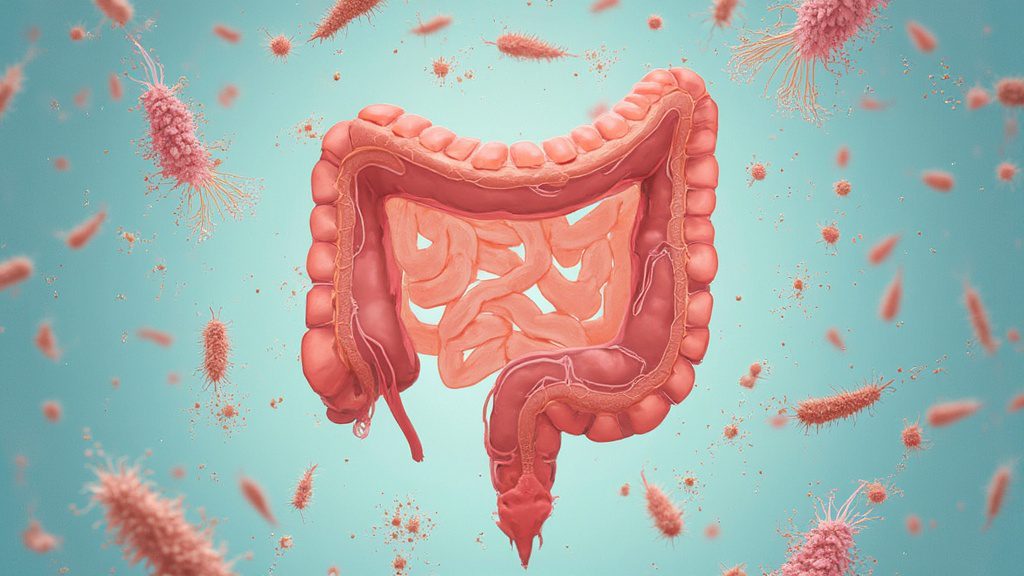
What happens next is the part I find genuinely interesting as a physician. When bacteria in your colon ferment that fiber, they don’t just consume it — they make something. The main byproducts are short-chain fatty acids: mostly acetate, propionate, and butyrate. Butyrate in particular is the preferred fuel for the cells lining your colon. Your gut lining is, in a real sense, partly fed by what your bacteria build out of the vegetables you ate.
That’s the mechanism worth carrying through the rest of this article. You eat the fiber, the bacteria eat the fiber, and then the bacteria feed your gut wall. Research links higher fiber intake and short-chain fatty acid production with markers of gut barrier function and a more diverse microbiome, though I’d be careful about how far anyone stretches those findings. Diversity is something researchers track, not a promise about how you’ll feel next Tuesday.
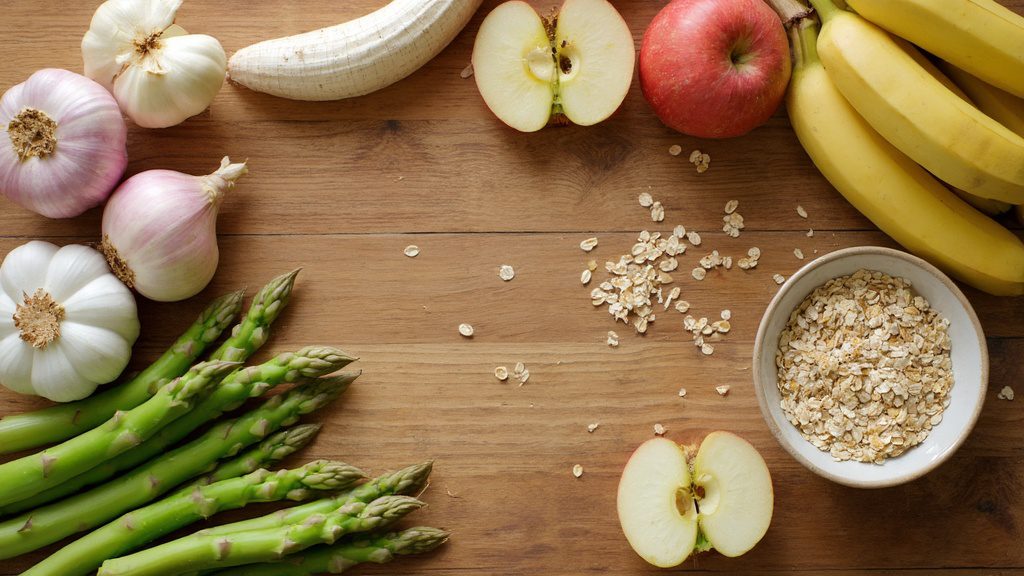
Here’s the practical translation. Nothing in that definition requires a supplement, a powder, or anything fermented. Prebiotics are a property of ordinary plant foods — onions, oats, beans, slightly green bananas. If you cooked with garlic this week, you already ate prebiotic foods, whether or not anyone labeled them that way.
Prebiotic vs Probiotic: The Difference That Confuses Everyone
Prebiotics are food. Probiotics are the living organisms that eat it. Garlic, onions, and oats are prebiotic foods; yogurt, kefir, and kimchi are probiotic foods. One letter apart, completely different jobs.
The way I explain it in clinic is a garden. Probiotics are the seedlings you plant. Prebiotics are what you work into the soil so the seedlings survive. Plant without feeding and most of what you put in never establishes. Feed without planting and you’re still improving conditions for whatever’s already growing — which, in a gut you’ve had your whole life, is quite a lot.
What Prebiotics Do
Prebiotics work on the residents. You already have trillions of bacteria in your colon, and the fiber you eat helps determine which ones thrive and which get crowded out. Nothing new arrives; you’re shifting the balance of what’s already there. It’s a slow, steady process measured in weeks of consistent eating, not a single meal.
What Probiotics Do
Probiotics bring in outside organisms, usually through fermented foods or capsules. The honest caveat is one the supplement aisle doesn’t advertise: most probiotic strains are transient. They pass through, do whatever they do while they’re present, and largely don’t set up permanent residence. That doesn’t make them useless — several strains have been studied for specific, narrow effects — but it does mean any benefit depends on continuing to eat them, not on a one-time colonization.
Worth knowing: not everything fermented delivers live bacteria. Pasteurized sauerkraut, most store-bought pickles, sourdough bread, and beer all involve fermentation, but heat or processing kills the cultures. The kimchi in my family’s refrigerator was never heated, which is why it stays alive and keeps getting more sour week after week. A jar pasteurized for shelf stability won’t do that.
Synbiotics: When You Eat Both Together
A synbiotic is just prebiotics and probiotics in the same meal — the seedling and the soil amendment at once. Researchers use the term formally, and there’s ongoing work on whether specific pairings do more together than separately. The evidence for designed synbiotic combinations is still developing, so I wouldn’t oversell it.
The everyday version requires no product at all. Korean home cooking does this without trying: kimchi (live cultures) served alongside rice, garlic, scallions, and vegetables (the fiber). Yogurt with sliced banana and oats works the same way. So does a bowl of miso soup with leeks. You don’t need to engineer it — a plate with both a fermented food and a plant food is already there.
If the terminology still feels slippery, the full comparison gets its own piece: . For everything here, only one half matters — the fiber side, and which foods actually carry it.
12 Everyday Prebiotic Foods (and How Much You Actually Get)
Most prebiotic food lists open with chicory root and Jerusalem artichoke — technically correct, practically useless, because almost nobody is buying either one this week. These twelve are ordinary grocery store items, and several are probably in your kitchen right now. I’ve ordered them by how easy they are to work into real meals, not by fiber content.
One note on numbers first. Fiber values vary with variety, ripeness, and cooking, and inulin content specifically is measured far less consistently than total fiber. Where the USDA FoodData Central database gives a reliable total fiber figure, I’ll use it. Where inulin content genuinely varies across sources, I’ll say so rather than invent a number.
Vegetables: Garlic, Onion, Leek, Asparagus
Garlic is the most concentrated prebiotic that people already cook with regularly. It carries inulin and fructooligosaccharides (FOS), a shorter-chain relative. A clove or two barely registers in fiber grams, but it’s dense enough that quantity isn’t the point — frequency is. Raw retains more of the fiber than long-cooked, though cooked garlic still contributes.
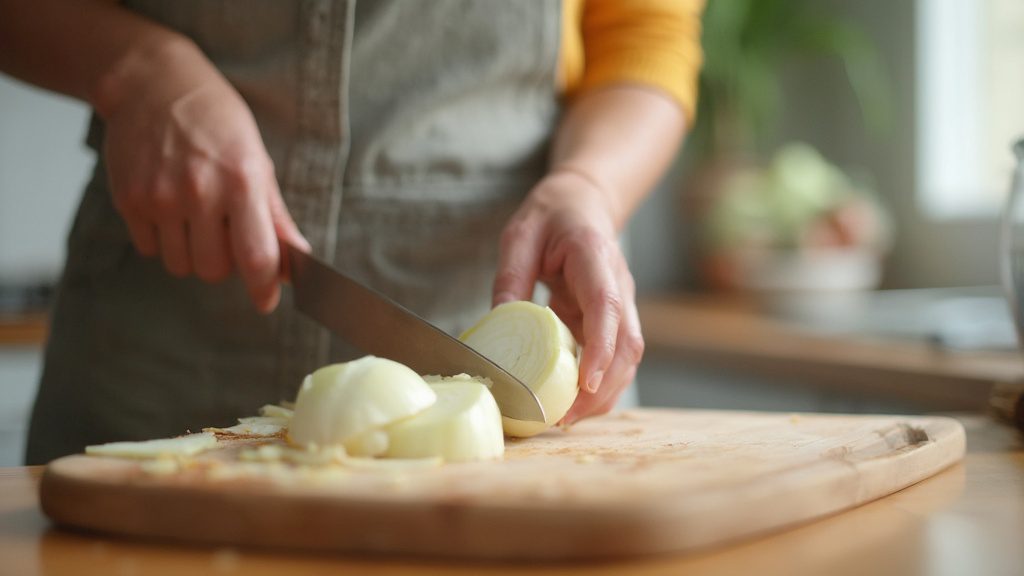
Onions carry the same inulin and FOS family. Roughly 2 grams of total fiber per medium onion, per USDA data. Their practical advantage over garlic is volume — you can eat half a cup without noticing, which you can’t do with garlic.
Leeks are onions’ milder cousin and one of the more underused options in American kitchens. About 1.6 grams of fiber per cup, raw. Soups, braises, and eggs all take them easily.
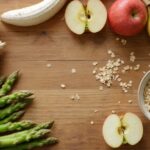
Asparagus contains inulin and delivers roughly 2.8 grams of fiber per cup. It holds more of that fiber raw or lightly cooked than boiled to softness.
Fruits: Slightly Green Bananas, Apples
Slightly green bananas are the one item where ripeness changes everything. An underripe banana is high in resistant starch — starch that resists digestion in the small intestine and ferments in the colon instead. As it ripens, that starch converts to sugar and the prebiotic value drops. If you’re eating bananas for your gut rather than for sweetness, buy them a few days early.
Apples contain pectin, a soluble fiber that gut bacteria ferment. About 4.4 grams of total fiber in a medium apple with the skin on, per USDA. Peel it and you lose a meaningful share.
Grains: Oats, Barley
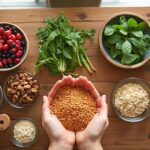
Oats carry beta-glucan, one of the better-studied fermentable fibers. Roughly 4 grams of fiber per cup of cooked oatmeal. Steel-cut and rolled both work; instant packets are more processed but still contain beta-glucan.
Barley is the quieter option and, gram for gram, one of the highest-fiber grains available — around 6 grams per cooked cup. It’s cheap, it holds up in soup, and Americans rarely buy it. In Korean cooking, barley mixed into rice (boribap) is ordinary home food, not a health trend.
Legumes & Seeds: Lentils, Chickpeas, Flaxseed
Lentils deliver roughly 15.6 grams of fiber per cooked cup, per USDA — far more than anything else on this list. They also cook in twenty minutes without soaking.
Chickpeas land around 12.5 grams per cooked cup and contain galactooligosaccharides (GOS), another recognized prebiotic fiber family. Canned counts; drain and rinse.
Flaxseed contributes about 2 grams of fiber per tablespoon, ground. Whole seeds pass through largely intact, so grinding matters. Stir it into oatmeal or yogurt.
The Resistant Starch Trick: Cooked-Then-Cooled Potatoes and Rice
Cook potatoes or rice, chill them in the refrigerator, and some of the digestible starch reorganizes into resistant starch — the same fermentable form found in green bananas. The process is called retrogradation, and it’s one of the few prebiotic gains you get for free in the kitchen. Potato salad made the day before. Leftover rice from last night. Reheating doesn’t undo all of the change.
Twelve items, and the fiber they’d add if you ate a serving of each is well past what most American adults get in a day. Nobody needs to do that — covers what the actual daily target looks like and how far average intake falls short.
What I Tell Patients Who Ask Where to Start
Pick one food. Eat it at the same meal, most days, for two weeks. That’s the whole recommendation, and in my practice it’s the only version people are still doing a month later.
The failure pattern is consistent enough that I can usually see it coming. Someone reads a list like the one above, goes to the store, buys ten of the twelve items, and cooks an ambitious week of lentil soup and barley bowls. By day five the produce is wilting, the enthusiasm is gone, and the conclusion becomes “I tried the gut thing and it didn’t stick.” Nothing was wrong with the foods. Twelve simultaneous changes require twelve simultaneous habits, and habits don’t install in parallel.
Here’s what a single change looks like in practice. Oatmeal at breakfast — not oatmeal sometimes, oatmeal as the default, so you stop deciding every morning. Or half an onion into whatever you’re already cooking for dinner. Or an open can of chickpeas in the fridge that goes into lunch. One decision, made once, repeated until it stops feeling like a decision.
Two weeks is the interval I suggest, and it’s a practical number rather than a research finding. It’s long enough to know whether the food fits your actual life — your schedule, your cooking, what your family will eat — and long enough that any early gas or bloating has usually settled. If it’s still a chore after two weeks, that food is the wrong one for you. Swap it. Lentils are excellent and some people simply will not eat them; that’s fine, there are eleven others.
One more thing I’ve noticed that isn’t in any guideline. The people who succeed at this almost never frame it as adding a health food. They frame it as changing what’s already on the plate — the rice becomes barley-and-rice, the sandwich gets raw onion, the yogurt gets ground flaxseed. Substitution survives; addition usually doesn’t. My grandmother never thought of boribap as a fiber strategy. It was just what rice was.
One caution worth stating plainly: this “start with one” approach assumes a generally healthy adult making ordinary diet changes. If you’re managing a diagnosed digestive condition, recovering from GI surgery, or following a restricted diet your clinician set up, the sequencing should come from the person who knows your history — not from a list on the internet.
Adding Them Without Wrecking Your Stomach
Gas and bloating in the first week or two are common and usually temporary. They’re the predictable result of fermentation — bacteria eating fiber produce gas as a byproduct, and if you’ve suddenly given them much more to work with, you’ll notice. It isn’t a sign the food is wrong for you, and it isn’t damage.
The fix is pace. Increase gradually rather than all at once, which is the same advice the Dietary Guidelines for Americans gives for raising fiber intake generally. Those guidelines put adequate fiber in the range of roughly 25 to 34 grams per day for adults, depending on age and sex, and note that most Americans fall well short. The gap is real — but trying to close it in one weekend is what produces the miserable week that makes people quit.
A workable ramp looks like this. Start with half of a normal serving: half a cup of lentils instead of a full cup, half an apple, one tablespoon of ground flaxseed instead of two. Hold there four or five days. If it’s comfortable, go to the full serving. If it isn’t, hold longer. There’s no prize for getting there faster, and the bacteria adapt on their own schedule.
Water matters more than people expect. Fermentable fiber pulls water into the colon, and if your fluid intake doesn’t rise alongside the fiber, you can end up with the opposite of what you wanted — harder stool, more straining, more discomfort. I don’t hand patients a fixed number of glasses, because the honest answer depends on body size, activity, and climate. What I do say: if you’re increasing fiber and not drinking more, you’ve done half the change.
A few specifics that come up often. Beans and lentils are the most common culprit for gas; rinsing canned ones or cooking dried ones thoroughly removes some of the fermentable sugars. Raw onion and raw garlic hit harder than cooked. Resistant starch from cooled rice and potatoes tends to be gentler than legumes for most people, which makes it a reasonable starting point if your stomach is sensitive.
Now the part that isn’t about pacing. Some symptoms aren’t an adjustment period, and the difference is worth knowing. Bloating that keeps escalating instead of settling. Pain rather than pressure. A persistent change in your bowel habits. Blood in the stool. Unintended weight loss. Any of those deserve a conversation with your own physician rather than another week of dietary tinkering — and that’s true whether or not you recently changed how you eat.
There’s also a real subgroup for whom high-inulin foods reliably cause trouble. People with IBS often react strongly to fermentable carbohydrates, and low-FODMAP protocols exist precisely because garlic, onion, and legumes can be poorly tolerated by that group. If that describes you, this isn’t a matter of pushing through slowly — it’s a matter of working out which specific fibers you tolerate, ideally with a clinician or dietitian who can supervise the elimination and reintroduction properly.
For most healthy adults, though, the arc is unremarkable: a somewhat gassy first ten days, then normal. The wider picture of how fiber, fermented foods, and daily habits fit together is covered in .
Quick Answers About Prebiotic Foods
What food is highest in prebiotics?
By concentration, chicory root — roughly 40 to 50 percent inulin by weight, which is why manufacturers extract it and add it to fiber bars. Among foods people actually eat, raw garlic and raw onion are the densest common sources, and Jerusalem artichoke ranks high but rarely shows up in an American kitchen. That said, concentration isn’t the useful metric. A cup of lentils delivers far more fermentable fiber to your colon than two cloves of garlic, simply because you eat more of it.
When should I eat prebiotic foods — morning or night?
Timing doesn’t appear to matter much, and I’d be skeptical of any confident claim otherwise. Fermentation happens in the colon hours after a meal, so the clock on your kitchen wall isn’t the variable — total intake across the day is. One practical note: if a big serving of legumes leaves you gassy, eating it at lunch rather than right before bed is more comfortable for most people.
Do I need a prebiotic supplement if I eat these foods?
No, not if you’re regularly eating the kinds of foods listed above. Whole foods deliver fermentable fiber alongside vitamins, minerals, and a mix of fiber types that a single isolated inulin powder doesn’t reproduce. Supplements have a legitimate role in specific clinical situations, but for a generally healthy adult eating vegetables, grains, and legumes, they’re solving a problem food already solved. If you’re considering one for a particular reason, that’s a question for your own clinician.
Can prebiotic foods help with constipation?
Fiber intake is associated with stool regularity, and prebiotic fibers contribute to that — but the effect varies a lot between individuals and fiber types. Some fermentable fibers add bulk and draw in water; others ferment quickly and produce more gas than bulk. Adequate fluid alongside the fiber matters as much as the fiber itself. If constipation is persistent, painful, or new for you, that’s worth evaluating with a physician rather than treating as a fiber shortfall, since the causes range well beyond diet.

Here’s what I’d take from all of this: prebiotic foods aren’t a category you have to shop for. They’re mostly things already sitting in your kitchen, and the only real question is whether you eat enough of them, often enough, for your gut bacteria to notice. If the prebiotic-versus-probiotic confusion was the thing tripping you up, I hope the garden image sticks: probiotics are the plants, prebiotics are what you feed the soil, and a diet that includes both tends to serve you better than chasing either one alone. My honest suggestion is to skip the twelve-item overhaul and pick one — garlic in tonight’s dinner, oats tomorrow morning, a cup of lentils this week — and hold it for two weeks before adding anything else. Go slowly, drink water alongside the extra fiber, and expect a short adjustment period rather than reading it as a sign something’s wrong. If bloating, pain, or changes in your bowel habits stick around or get worse, that’s a conversation for your own doctor, not another diet tweak. And when you’re ready to see how prebiotics fit alongside fermented foods, fiber targets, and the rest of the picture, is where I’d send you next.
함께 보면 좋은 글
- the full prebiotic vs probiotic breakdown
- our complete gut health guide
- fermented foods that actually contain live cultures
- how much fiber you actually need each day