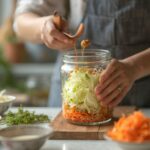
The bloating that shows up after every meal. The food list that keeps getting shorter. A search history full of gut-healing advice that contradicts itself. That’s the situation this is written for, and it usually starts long before anyone gets a clear answer from a doctor. Fermented foods come up constantly in that search, but the claims run from “cures leaky gut in two weeks” to “makes IBS worse,” and both camps sound equally sure of themselves. What follows sorts the fermented foods that actually contain live cultures from the ones that only look the part, sets a starting amount that won’t backfire in week one, and names the situations where holding off is the smarter call. Where the research is solid, I’ll say so. Where it’s thin, I’ll say that too.
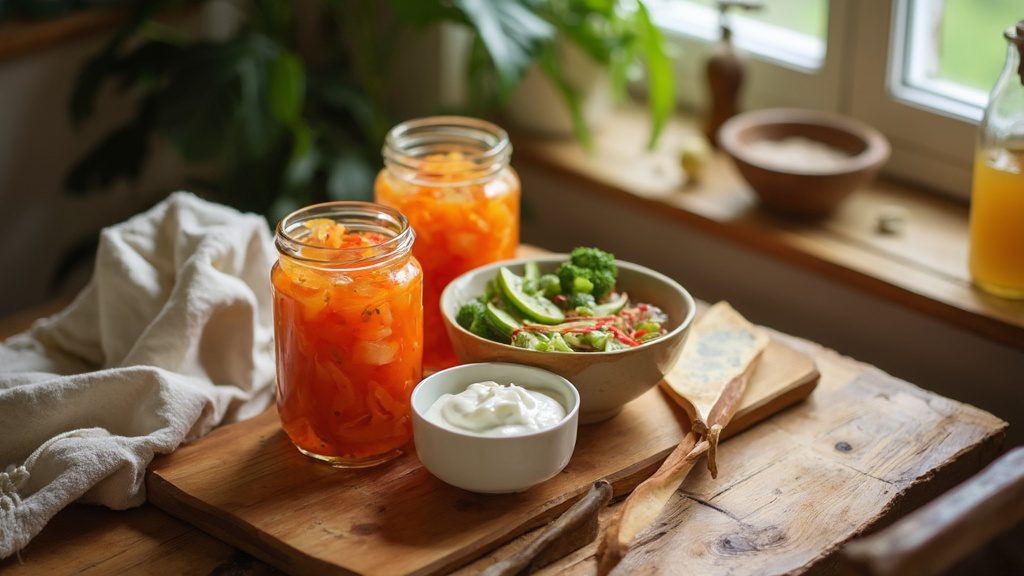
Can Fermented Foods Really Help a Leaky Gut?
Short answer: they may help, and the strongest human evidence points to microbiome diversity and inflammation markers — not to sealing up an intestinal lining. That distinction matters more than it sounds like it does. A Stanford trial published in Cell in 2021 put healthy adults on a high-fermented-food diet for ten weeks and found increased gut microbial diversity along with decreased levels of several inflammatory proteins in the blood. A real, measured result. What that trial did not do is test whether fermented foods repair a leaky gut, because “leaky gut” as a standalone diagnosis isn’t something medicine currently recognizes or measures in the clinic.
Here’s where I’d ask for a little patience with the terminology. Intestinal permeability is a genuine, measurable phenomenon. Researchers study it, and it’s documented in conditions like celiac disease, inflammatory bowel disease, and after heavy alcohol use. “Leaky gut syndrome” — the version circulating online as the explanation for fatigue, brain fog, joint pain, and every kind of bloating — is a much bigger claim built on a much smaller foundation. If you want the full picture on that gap, it’s worth reading on what “leaky gut” actually means before you build a diet around it.
So why write about fermented foods at all? Because the practical advice holds up even when the label is shaky. Whatever is driving your symptoms, a more diverse gut microbial community and a lower inflammatory load are reasonable things to aim for, and fermented foods are one of the few dietary levers with human trial data behind them. That’s a modest claim. It’s also an honest one, and I’d rather hand you something modest and true than something exciting and false.
Let me be blunt about one thing: nobody has shown that eating kimchi for two weeks closes up an intestinal barrier. The two-week healing timelines you’ll find in search results are marketing, not findings. When people do feel better on a fermented-food-forward diet, several things are usually happening at once — more fiber, fewer ultra-processed foods, more variety on the plate — and separating the fermentation from the rest is genuinely hard.
Three questions decide whether this is worth your effort, and the rest of this piece answers them in order. Which fermented foods actually contain live organisms, because a large share of what’s sold as fermented on American shelves doesn’t. How much and how fast, since the most common reason people quit is starting at a volume their gut wasn’t ready for. And who should hold off entirely or check with a physician first — a shorter list than the internet suggests, but a real one.
One more thing before we get to the foods. I grew up with kimchi at every meal, breakfast included, and the amount a Korean household eats in a day is not the amount I’d suggest you start with this week. Tolerance gets built. It doesn’t come standard. That’s as true of my own family’s table as it is of yours.

How Fermentation Supports the Gut Barrier
Three mechanisms carry most of the plausible benefit: the live organisms themselves, the compounds they produce while fermenting, and the changes fermentation makes to the food before you ever swallow it. Only one of the three depends on bacteria surviving the trip through your stomach — worth knowing, because that’s the objection you’ll hear most often.
Start with the live microbes. When you eat unpasteurized kimchi or a spoonful of live-culture yogurt, you’re swallowing lactic acid bacteria, mostly Lactobacillus and related species — the workhorses of vegetable fermentation. Most of them don’t move in permanently. They pass through, and within a couple of weeks of stopping, stool samples generally look like they did before. That sounds like a strike against the whole idea, but transient organisms still do things on the way through. They compete with less desirable bacteria for space and nutrients. They interact with immune cells lining the intestine. They shift the chemical environment of the colon. According to the NIH Office of Dietary Supplements probiotics fact sheet, effects from probiotic organisms tend to be strain-specific and generally stop when consumption stops — a fair description of fermented foods too. The benefit here is a subscription, not a purchase.
The second mechanism is the one I find more interesting, and it’s the part most articles skip. Fermentation is metabolism happening outside your body. Bacteria eat the sugars in cabbage or milk and leave behind organic acids, peptides, vitamins, and other small molecules — collectively the reason sauerkraut tastes sour and kimchi develops that carbonated tang after a few weeks in the fridge. Some of these compounds have measurable effects on human cells in laboratory work. The International Scientific Association for Probiotics and Prebiotics, in its 2021 consensus statement on fermented foods, made the point that a food’s benefits may come from these microbial metabolites and the transformed food matrix, not only from viable microbes. Which is why even some pasteurized ferments may retain value, though less of it.
Short-chain fatty acids deserve their own note, because they get named constantly and misattributed almost as often. Butyrate is the primary fuel source for the cells lining your colon, and it does appear to support the integrity of that lining. But butyrate is mostly produced in your colon, by your own resident bacteria fermenting dietary fiber. It isn’t delivered ready-made by a jar of kimchi. So when someone tells you fermented foods feed your gut lining with butyrate, the honest version is this: fiber does that, and fermented vegetables happen to bring fiber along with everything else. Cabbage is still cabbage.
The third mechanism is the least glamorous and the most reliably true. Fermentation partially digests food in advance. Bacteria in yogurt and kefir consume much of the lactose, which is why people who bloat after a glass of milk often handle kefir without trouble. In soy fermentation — miso, tempeh, natto — the process breaks down phytates and complex oligosaccharides that would otherwise reach the colon intact and get fermented there, producing gas. None of this repairs anything. It just means less undigested material arriving in the wrong place, which for an already irritable gut can matter more than any microbiome effect.
So where does that leave the barrier itself? Honestly, in the middle of an open question. There’s decent mechanistic reasoning connecting a more diverse microbial community, better butyrate production, and lower systemic inflammation to a more resilient intestinal lining. There are animal studies showing specific strains affecting tight junction proteins — the structures that control what slips between intestinal cells. What’s missing is the human trial that puts people with permeability problems on fermented foods and measures the barrier afterward. As far as I know, that study hasn’t been done at the quality we’d need.
The mechanism is plausible and partly demonstrated. The last link in the chain is inference rather than evidence, and I’d hold it loosely. What isn’t in doubt is that fermented foods diversify the microbial input to your gut, and diversity is one of the few microbiome findings that’s held up across populations and study designs.
Probiotic vs. Prebiotic vs. “Just Pickled”: Reading the Label
Most of the sauerkraut sold in American grocery stores contains no live bacteria at all. It was heated to make it shelf-stable — excellent for food safety, fatal for the organisms you’re shopping for. The single most useful skill here isn’t knowing which foods are fermented. It’s knowing which jars still are.
Live-culture vs. pasteurized — what the label tells you
The fastest test is location. If it’s sitting on a dry shelf in the condiment aisle at room temperature, the live organisms are gone. Refrigeration isn’t a marketing choice for these products, it’s a requirement — living cultures keep working and would eventually pressurize a sealed jar. So: refrigerated case first, always.
Then check the ingredients. Real lacto-fermented vegetables need almost nothing. Cabbage, salt, water, maybe spices. That’s it. If you see vinegar high on the list, you’re holding a pickle, not a ferment. Vinegar produces the sour taste directly instead of letting bacteria produce it over weeks, and while vinegar pickles are perfectly good food, they aren’t delivering microbes. This is the trap most people fall into. A jar of deli-style pickles and a jar of naturally fermented cucumbers look nearly identical on the shelf and behave completely differently in your gut.
For dairy, the phrase to look for is “live and active cultures.” The National Yogurt Association runs a voluntary seal program using that language, and while not every good yogurt carries the seal, its presence is a reliable signal. Kefir will list its cultures too, usually a longer roster than yogurt’s.
A few more tells. “Raw” and “unpasteurized” on a vegetable ferment mean what you want them to mean. “Naturally fermented” is unregulated and sometimes means nothing at all. Cloudy brine and visible bubbling when you open the jar are good signs — that’s active fermentation. Korean kimchi sold in refrigerated cases is generally live, and if the lid domes up slightly in your fridge after a week, that’s carbon dioxide from bacteria still working. My grandmother’s kimchi crock would hiss when it was opened in late winter. Same principle, no label required.
Kombucha deserves a caution the others don’t. It’s genuinely fermented, but sugar content varies enormously between brands, and some products are diluted, pasteurized, or re-sweetened after fermentation. Read the nutrition panel, not the front of the bottle.
Probiotic foods vs. prebiotic fiber (and why you need both)
Probiotics are live organisms you swallow. Prebiotics are the fibers those organisms — and the ones already living in you — eat. Think of it as the difference between adding new tenants and stocking the pantry. Adding tenants without food doesn’t accomplish much.
This matters practically, because the butyrate question from earlier resolves right here. Your resident colon bacteria produce butyrate when they ferment fiber, so if you want that mechanism working, prebiotic fiber does more of the lifting than any jar of ferment. Onions, garlic, leeks, asparagus, slightly underripe bananas, oats, barley, cooked-and-cooled potatoes and rice. Standard sources, none of them exotic.
One convenient thing about fermented vegetables: the fiber comes attached. A serving of kimchi is cabbage, radish, scallion, and garlic — prebiotic material and live cultures in the same forkful. That’s part of why whole foods tend to outperform isolated supplements in the food-versus-pill comparison, which is worth reading about separately in .
There’s a catch for the people most likely to be reading this. Prebiotic fibers are fermentable by definition, and fermentation in your colon produces gas. If bloating is your main complaint, loading up on garlic, onion, and inulin-fortified products can make the first week worse rather than better. That’s not a reason to avoid fiber permanently. It’s a reason to increase it slowly enough that your microbial population can keep up.
One last distinction, since these terms get mixed constantly. “Postbiotic” refers to the metabolites and inactivated microbial components left behind after fermentation — the compounds ISAPP flagged as potentially beneficial on their own. It’s a legitimate research category and an increasingly common marketing word. Treat claims built on it with the same skepticism you’d apply anywhere else: the science is early, and the label is unregulated.
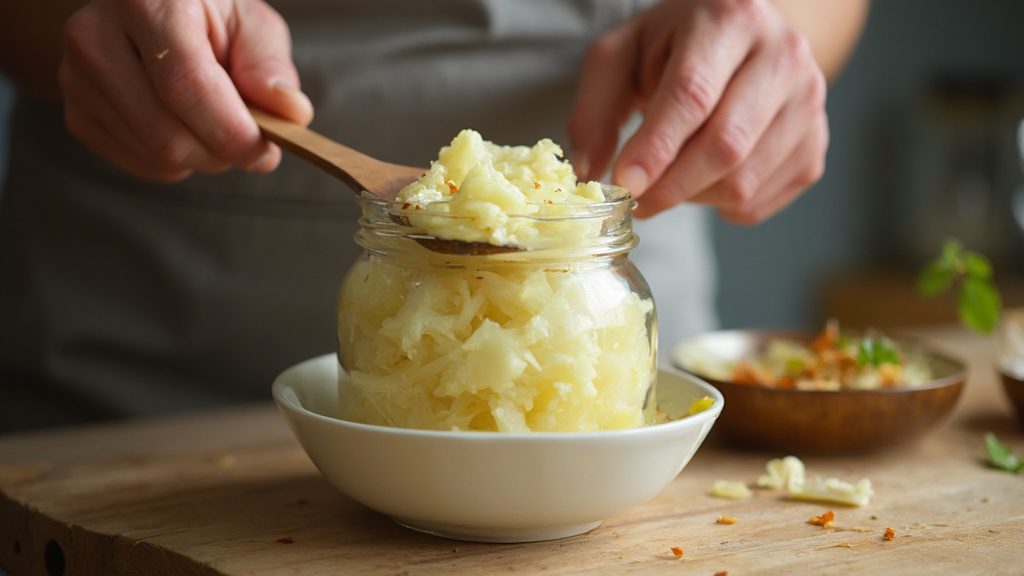
8 Fermented Foods Worth Adding (and What Each Brings)
If you’re only going to add one thing, make it the one you’ll actually eat four times a week. That’s not a dodge. Consistency beats optimization here, because the effects fade when you stop. What follows is organized by category, with live-culture status, a sane starting serving, and the specific catch for each.
Dairy ferments (yogurt, kefir)
Yogurt is the easiest entry point in an American kitchen and the one most likely to be undone by sugar. Plain, unsweetened, “live and active cultures” on the label — that’s the version worth eating. Flavored yogurts routinely carry as much sugar as a dessert, which undercuts the point entirely. A standard serving is about ¾ cup. Greek-style is strained, so it’s higher in protein and lower in lactose, and often better tolerated. The catch: if dairy already bothers you, start with a few tablespoons, not a full cup.
Kefir is the more interesting of the two. It’s fermented with a broader mix of bacteria and yeasts than yogurt, which means more microbial variety per serving, and it’s usually well tolerated by people who can’t handle milk, since most of the lactose is consumed during fermentation. Start at ¼ cup. It’s tart and slightly fizzy, and it will surprise you the first time. The catch: kefir tends to produce noticeable gut activity faster than yogurt does. That’s fine, but don’t start with a full glass on a workday.
Vegetable ferments (kimchi, sauerkraut)
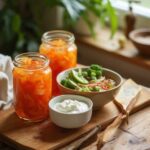
Kimchi is what I know best, so let me be specific. Traditional napa cabbage kimchi is fermented with salt, gochugaru (Korean red pepper flakes), garlic, ginger, and usually jeotgal (salted seafood), and it keeps developing for months in the refrigerator. Young kimchi is crisp and mild. Older kimchi turns sour and soft, and in Korean home cooking that’s when it goes into stews and pancakes rather than onto the plate raw. A reasonable serving is about ¼ cup — a small side dish, not a salad portion. Two catches. Sodium first: USDA FoodData Central entries for kimchi list a few hundred milligrams per half-cup serving, and brands vary widely, so check the panel. Second, most commercial kimchi contains fish sauce or salted shrimp, which matters if you’re vegetarian. Vegan versions exist and ferment perfectly well.
Sauerkraut is the lowest-friction option for most American readers, assuming you buy it refrigerated. Cabbage and salt, nothing else required. A tablespoon or two alongside a meal is a real serving — you don’t need a bowl of it. It’s noticeably higher in fiber than yogurt and brings its own prebiotic material. The catch is the same sodium question, and there’s no way around it: salt is what makes the fermentation safe, so there’s no low-sodium version worth trusting.
Soy ferments (miso, tempeh, natto)
Miso is fermented soybean paste, and it’s the one most often wasted through overheating. Boiling kills the live organisms, so if that matters to you, stir it into soup after you’ve taken the pot off the heat. A tablespoon is a serving. The catch is sodium, and it’s a serious one — miso is among the saltiest things in a normal kitchen, with USDA entries showing several hundred milligrams per tablespoon. Treat it as a seasoning, which is how it’s used anyway.
Tempeh is fermented soybean cake, firm enough to slice and cook like a protein. The honest note: it’s typically cooked before eating, which means the live cultures are gone. What remains is the transformed food matrix — more digestible protein, broken-down phytates, substantial fiber. Worth eating. Just not for the microbes.
Natto is fermented soybeans with a stringy texture and a smell that ends the conversation for a lot of people. It’s fermented with Bacillus subtilis, a spore-forming organism that survives stomach acid better than lactic acid bacteria do, and it’s a notably rich source of vitamin K2. I include it because it’s genuinely distinctive, not because I expect most readers to adopt it. The catch: vitamin K interacts with warfarin and similar blood thinners, so if you take one, talk to your physician before adding natto regularly.
Fermented drinks (kombucha)
Kombucha is fermented sweetened tea, and it’s the category where label-reading matters most. Live versions are refrigerated and will list residual sugar on the panel — some brands land close to soda, others are nearly dry. Start with 4 ounces, not a full bottle. Three catches worth knowing: it contains small amounts of alcohol from fermentation, it’s mildly caffeinated because it starts as tea, and the carbonation alone can worsen bloating in people already sensitive to gas. It’s the fermented food I’d suggest last for someone whose main complaint is bloating.
A note on what’s missing here. Fermented vegetables beyond cabbage — Korean radish, cucumber, and green onion all ferment beautifully — belong on this list too, and they’re often easier to make at home than to find in a store. Whether you should be making your own is a separate conversation, covered in . For now the shorter point stands: pick two from different categories, keep the servings small, give it a month.
How Much, How Often: Starting Without Making Symptoms Worse
One food, one tablespoon, once a day. That’s the starting dose, and it’s deliberately smaller than what most articles suggest. Increase every few days only if the previous amount went fine, and hold wherever your gut is comfortable. People who quit on fermented foods almost never quit because the food didn’t work. They quit because they started at a serving that would be normal for someone who’d been eating it for years.
Pace matters more than the ceiling. A reasonable schedule: a tablespoon daily for the first week, two tablespoons in week two, a small side-dish portion — roughly a quarter cup — by weeks three or four. If a step produces more gas or bloating than you’re willing to live with, don’t push through. Drop back to the last amount that felt fine, hold there another week, then try again. Your resident microbial community does adjust to a changed input, but it adjusts on a timescale of weeks, not days.
One food at a time, too. Add kefir and kimchi and kombucha in the same week and your gut objects, and you’ve learned nothing about which one caused it. Give a single food ten days to a couple of weeks before introducing the next. That’s slower than anyone wants. It’s also the only way to end up with useful information about your own tolerance.
Time of day matters less than the internet suggests. There’s no strong evidence for a magic window, and stomach acid is the same obstacle at 7 a.m. as at 7 p.m. What does seem to help in practice is eating fermented foods with a meal rather than on an empty stomach. Food buffers stomach acid, which gives the organisms an easier passage, and it tends to be gentler on people who are already sensitive. In Korean meals, kimchi arrives alongside rice and soup, never alone. That arrangement is really about balance and salt, but it happens to be sound on this point too.
Frequency beats volume. Because these effects generally fade once you stop, a small daily serving does more than a large weekly one. The Stanford trial that showed increased microbial diversity ran participants up to about six servings a day across ten weeks — a research protocol, not a recommendation for someone with an irritable gut, and participants got there gradually. Somewhere between one and three modest servings a day, most days, is a target that’s both achievable and defensible.
Variety is the part people skip. Different ferments carry different organisms, so rotating kefir, kimchi, and sauerkraut across a week delivers a broader microbial input than eating one thing faithfully. Once you’ve established tolerance for two or three foods individually, mixing them is more valuable than optimizing any single one.
Now the judgment call, because this is where readers get stuck. Some increase in gas during the first week or two is common and usually settles. It looks like mild bloating in the evening, more audible gut activity, a change in stool frequency — and it fades as you hold steady at the same amount. What doesn’t belong in that category: pain rather than pressure, symptoms that keep escalating instead of plateauing, diarrhea lasting more than a few days, or a reaction that arrives fast and hard after a small serving. That isn’t adjustment. That’s a signal to stop and get evaluated, especially if fermented foods reliably reproduce it.
The simplest tracking method is also the most useful. Write down what you ate, how much, and how you felt about six hours later. Three lines a day. After a month you’ll have something concrete to bring to your physician or dietitian, which beats “I tried gut stuff and I’m not sure” by a wide margin.
One last piece of context that gets lost in the enthusiasm. Adding fermented foods while continuing everything that irritates your gut is like adding fresh water to a running tap — the input changes, the situation doesn’t. Alcohol, regular NSAID use, very low fiber intake, and heavy ultra-processed food loads all work against you here, and removing an irritant often produces a faster change than adding a ferment does. What to pull back on is a longer conversation, covered in . But if you’re going to invest four weeks in this, invest them in both directions at once.

What I Look For in Practice — A Clinician’s Read
Everything up to this point has been evidence and dosing. This part is judgment — my own pattern recognition, not research findings — and I want that labeled clearly before you weigh it.
People who tend to do well with fermented foods share a few traits. Their symptoms are diffuse rather than sharp: bloating that builds through the day, irregular but not alarming stools, a general sense that digestion is sluggish. Their baseline diet is low in fiber and variety — the same six or seven foods on repeat, most of them processed. They aren’t in pain. And when they add something fermented, they add it to an otherwise reasonable meal instead of using it to redeem a bad one. In that group, four to six weeks of consistent small servings often produces something worth noticing. Not dramatic. Noticeable.
The people who do poorly are usually identifiable in advance, and it’s rarely the fermentation itself that’s the problem. Three patterns come up over and over.
The first is speed. Someone reads an article, buys three products, and eats all of them at full serving size on day one. By day three they’re miserable and they’ve concluded that fermented foods don’t agree with them. What actually happened was a dosing error, and the fix is starting over at a fraction of the amount. I’d guess this accounts for most self-reported fermentation intolerance.
The second is that the symptom map doesn’t fit. When someone tells me their bloating is severe within twenty minutes of eating almost anything, or that they’ve been quietly removing foods for a year and the list is down to eight items, fermented foods aren’t the right first move. Something else is driving that, and adding a fermentable, gas-producing food to an already reactive gut is more likely to muddy the picture than clarify it. The right step there is evaluation, not a grocery list.
The third is that the food is being asked to carry a load it can’t. I’ve watched people build elaborate gut protocols — bone broth, collagen, glutamine, four supplements, a strict elimination diet, kimchi at every meal — while sleeping five hours a night and drinking most evenings. The protocol isn’t the variable. Fermented foods are a small, real lever, and small real levers don’t overcome large ongoing ones.
There’s a fourth pattern worth mentioning, because it’s the one I find most interesting culturally. Americans who travel to Korea often report that their digestion feels different there, and they credit the kimchi. Maybe partly. But a Korean meal is also more vegetables, more variety, smaller portions of meat, less bread, and far less ultra-processed food than what most of them eat at home. Giving the whole effect to the fermented side dish is a very natural mistake — and it’s the same mistake the two-week healing articles make. When several things change at once, the most photogenic one gets the credit.
What I’d want you to take from this is a sense of proportion. Fermented foods are a reasonable, low-risk addition for most people with mild ongoing digestive complaints. They’re a poor substitute for figuring out what’s actually going on when the complaints aren’t mild.
Which brings me to the part I won’t soften. There are symptoms where diet experimentation should stop and evaluation should start, and they’re worth memorizing:
- Unintentional weight loss
- Blood in the stool, or black, tarry stools
- Pain that wakes you at night
- Persistent vomiting, or trouble swallowing
- Fever alongside digestive symptoms
- Iron-deficiency anemia found on bloodwork
- New, persistent change in bowel habits after age 45 or 50
- A first-degree relative with colorectal cancer, celiac disease, or inflammatory bowel disease
None of those are things fermented foods address, and none of them should be managed with a grocery list. If any apply to you, please make the appointment. The workup is straightforward and the information is worth having.
I’d add one softer trigger. If you’ve been honestly consistent for six to eight weeks — small servings, daily, one food at a time, tracked — and nothing has shifted at all, that’s useful information too. It doesn’t mean you failed at eating vegetables. It means the mechanism you’re targeting probably isn’t the one driving your symptoms, and a physician or registered dietitian can help you find a better target. Some of the most productive conversations I’ve had started with a patient handing me exactly that: a month of notes showing something reasonable, tried properly, that didn’t work.
Food is a good place to start. It’s a bad place to stop when the answers aren’t coming.
Who Should Be Careful with Fermented Foods
Fermented foods are safe for most healthy adults, but five groups have a real reason to slow down or check with a physician first: people with histamine intolerance, people with SIBO or hard-to-control IBS, anyone whose immune system is suppressed, anyone managing blood pressure or on a sodium-restricted diet, and anyone who’s pregnant. That’s the list. It’s shorter than the internet’s version, and each item has a specific mechanism behind it rather than a vague warning.
Histamine intolerance. Fermentation produces biogenic amines, histamine among them, as bacteria break down amino acids. That’s inherent to the process — the longer and more actively something ferments, the more accumulates. Most people clear it without noticing. People with reduced capacity to break histamine down don’t, and the result can look like flushing, headache, hives, nasal congestion, or a racing heart within an hour or two of eating. Aged and long-fermented products carry the most: aged cheeses, sauerkraut that’s been in the jar for months, well-ripened kimchi, fish sauce. If that pattern sounds familiar, raise it with your physician before you experiment further. Histamine intolerance is genuinely tricky to identify, and the elimination-and-rechallenge process goes better with guidance.
SIBO and difficult IBS. Small intestinal bacterial overgrowth means bacteria are populating a stretch of intestine where they shouldn’t be in numbers. Adding more fermentable material and more organisms to that situation can amplify exactly the symptoms you’re trying to reduce. Fermented vegetables also carry FODMAPs — garlic, onion, and cabbage all qualify — and Monash University, which developed and maintains the low-FODMAP framework, classifies fermented foods by portion size rather than banning them outright, because tolerance is dose-dependent. Some people with IBS do fine with small servings. Others reliably don’t. The American College of Gastroenterology’s IBS guideline, for its part, does not recommend probiotics for IBS symptom management based on current evidence — a useful reminder that “good for the gut” isn’t the same as “good for this gut.”
A suppressed immune system. This is the one place I’d say hold off rather than go slow. Live-culture foods are, by design, food containing large numbers of living organisms. In people with significantly compromised immunity — active chemotherapy, organ transplant with immunosuppressive medication, advanced HIV, certain immune deficiencies — organisms that are harmless to the rest of us have caused serious infections, and there are documented cases involving probiotic organisms specifically. The NIH Office of Dietary Supplements flags this population explicitly in its probiotics fact sheet. If you’re in it, please make this a conversation with your treating physician rather than a personal decision.
Sodium and blood pressure. Salt is what makes vegetable fermentation work — it selects for the bacteria you want and suppresses the ones you don’t — so there’s no meaningfully low-sodium version of sauerkraut or kimchi. That’s chemistry, not a manufacturer’s choice. The 2020–2025 Dietary Guidelines for Americans recommend limiting sodium to less than 2,300 mg per day for adults, and a few servings of fermented vegetables plus a tablespoon of miso can take up a real fraction of that. If you’re managing hypertension or on a sodium-restricted diet, count these foods rather than assuming a health food gets a pass. Rinsing sauerkraut lightly removes some surface salt, though it washes off some of the brine bacteria along with it.
Pregnancy. The concern here isn’t fermentation itself. It’s unpasteurized dairy. The FDA advises pregnant people to avoid soft cheeses and dairy products made from unpasteurized milk because of Listeria risk, which is uncommon but serious in pregnancy. Yogurt and kefir made from pasteurized milk and then cultured are fine. Commercially produced fermented vegetables from a reputable maker are generally considered acceptable, but home ferments during pregnancy are a reasonable thing to skip — and worth a direct question to your OB rather than a guess.
A few smaller cautions worth naming. Kombucha’s alcohol content is low but not zero, which matters in pregnancy and for anyone avoiding alcohol entirely. Home fermentation carries genuine safety requirements — adequate salt concentration, full submersion under brine, and knowing what mold looks like versus normal white kahm yeast — and the National Center for Home Food Preservation publishes tested procedures worth following rather than improvising. And if you take a medication where diet interacts directly, like the vitamin K situation with warfarin, consistency matters more than avoidance. Sudden changes are the problem.
None of this makes fermented foods risky in the ordinary sense. Kimchi has been a daily staple in Korean households for centuries, mine included, with no public health crisis attached to it. But “safe for most people” and “safe for you specifically” are different questions, and the second one sometimes needs someone who knows your history. If you fall into one of these groups and still want to try, the answer usually isn’t no. It’s smaller, slower, and with your physician in the loop.

If I had to compress all of this into one thing, it would be this: fermented foods are worth a place at your table, but they work slowly, quietly, and only when they’re actually alive. I’ve watched people spend months on jars of shelf-stable pickles that never contained a live culture in the first place. I’ve watched others go from zero to a full cup of kimchi overnight and conclude that fermentation “doesn’t agree” with them, when the real issue was the pace. So the plan is unglamorous. One refrigerated live-culture food, a spoonful at a time, with a meal, and two to four weeks of paying attention to what your own gut tells you. Write it down while you do. If the discomfort keeps building, or if you’re dealing with histamine sensitivity, a suppressed immune system, blood pressure concerns, or pregnancy, talk it through with your physician before you change much of anything — that conversation is worth more than any list I could write. And if you’re not sure where you stand on the basics, read up on what “leaky gut” actually means before you rearrange your grocery cart around it. Food is a reasonable place to begin. It just isn’t the whole answer, and I’d rather tell you that plainly than sell you a shortcut.
함께 보면 좋은 글
- what “leaky gut” actually means
- foods to avoid with leaky gut
- fermented foods vs probiotic supplements
- our full gut health food guide