There’s a red tub sitting in the international aisle, and a recipe that says “2 tablespoons gochujang” without explaining what that actually does to the dish. That gap — knowing the word but not the ingredient — is where most home cooks stall out. They either buy it and let it sit unopened, or skip it and wonder what the dish was supposed to taste like. The short version: gochujang isn’t hot sauce, and treating it like one is the mistake that ruins the first attempt. Here’s how it actually tastes, how much to use before you’ve built any instinct for it, and what to reach for on the nights you don’t have it.
What Gochujang Actually Is
Gochujang is a fermented Korean chili paste built from four core ingredients: gochugaru (Korean red pepper flakes), glutinous rice, fermented soybean powder, and salt. That soybean component is the part most Americans miss, and it’s the whole story. Gochujang belongs to the same family as miso and doenjang — Korean fermented soybean paste — not to the family of Tabasco and sriracha.
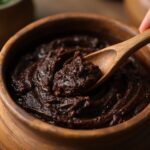
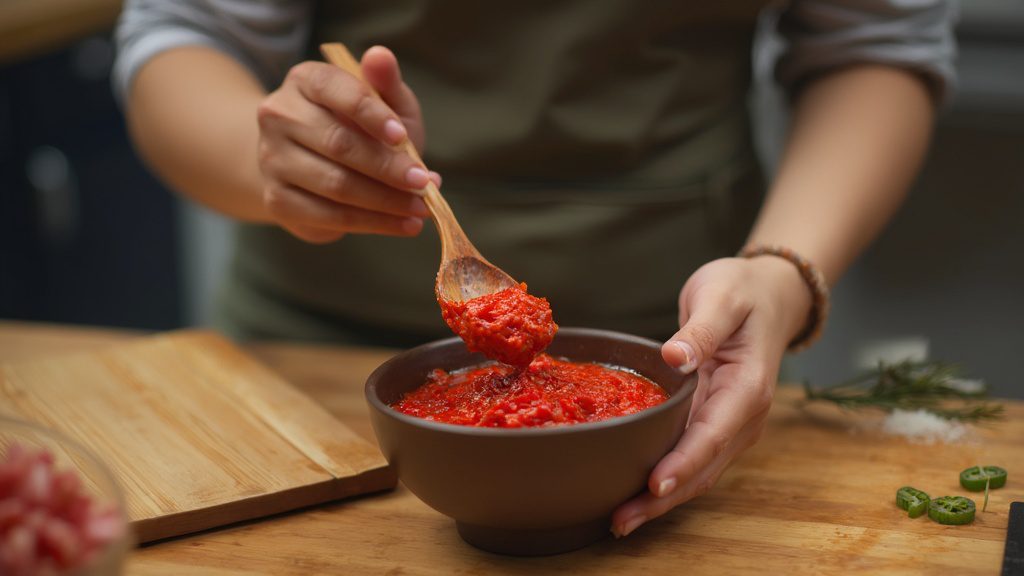
The texture tells you as much as the label does. Scoop a spoonful and it holds its shape, dense and glossy, closer to tomato paste than to anything you’d shake out of a bottle. That thickness comes from the rice, which does double duty: it gives the paste body, and its starches break down into sugars during fermentation. That’s why gochujang tastes sweet before it tastes hot.
The fermentation is what separates gochujang from a chili sauce someone blends and jars the same afternoon. Traditionally the mixture goes into an onggi — a breathable earthenware crock — and sits outdoors for months, sometimes through a full year of seasons. In the courtyards of older Korean homes you’ll still see a row of these crocks on a raised stone platform, lids propped open on sunny days. Enzymes from the fermented soybean starter slowly break the rice starch down into sugar and the soy proteins into amino acids. Those amino acids, glutamates among them, are the source of the savory backbone that makes gochujang taste deep rather than merely spicy.
Korea takes the definition seriously enough to write it down. Under the Korean Food Code, administered by the Ministry of Food and Drug Safety, gochujang is classified as a fermented seasoning (장류) with defined requirements for its red pepper and fermented soybean content. Which is to say: in Korea, a sweetened chili sauce can’t legally be labeled gochujang just because it’s red and thick. That matters in an American grocery store, where the category is looser and the shelf holds several things wearing the same name.
Two of those things are worth separating right now. Gochujang paste is the traditional product — thick, concentrated, sold in a red tub or a plastic tub with a foil seal. Gochujang sauce is a thinner, ready-to-pour condiment made from the paste, usually with added vinegar, sugar, garlic, and water. Both have their place. But when a recipe calls for gochujang and you use the sauce, you’re adding maybe a third of the concentration the recipe expected, plus a lot of vinegar it never asked for. The dish comes out thin and sharp, and nobody can say why.
One more term to file away, because mixing these up is the most common gochujang error I see: gochugaru is the dried pepper flake, an ingredient inside gochujang. It’s a dry spice with heat and a mild fruity note — no sweetness, no fermented depth, no body. Swapping one for the other doesn’t get you a close approximation. It gets you a different dish.
So, the honest one-line answer: gochujang is aged, savory, sweet-leaning, and moderately spicy, and it works in Korean cooking the way a concentrated paste works in yours — a base you build a dish on, not a finishing heat you shake on top.
What Gochujang Tastes Like (And How Spicy It Really Is)
Most gochujang is less spicy than sriracha, and considerably less spicy than a jar of crushed red pepper. The heat is real but slow. It arrives after the sweetness and the savory weight, builds over a few seconds, and settles into a warmth at the back of the throat rather than a sting on the tongue. If you’ve been avoiding gochujang because you don’t like spicy food, that reputation is mostly borrowed from the dishes it shows up in, not from the paste itself.
The four flavors in one spoon — sweet, savory, salty, spicy
Taste a little straight off the spoon and you can time the sequence. Sweetness lands first — not a candy sweetness, more like the background sweetness of roasted sweet potato. Underneath it sits the savory layer, thick and almost meaty. Salt runs through both. The chili heat comes last and lingers longest.
That order is the useful part. Because sugar and salt lead, gochujang seasons a dish even in amounts too small to make it spicy. A teaspoon stirred into a pot of beef and vegetable soup won’t register as heat at all — it’ll just make the broth taste rounder and more finished, the way a spoonful of tomato paste or fish sauce does. Cooks who think of gochujang only as a heat source never discover this, and it’s exactly why a Korean home kitchen reaches for it constantly.
The other thing worth naming: gochujang is thick. It coats. Sriracha runs off a chicken thigh; gochujang clings to it and caramelizes. That physical difference shapes what you can do with the two even more than the flavor difference does.
Heat levels on the label: mild (순한맛) to very hot (매우매운맛)
Korean gochujang is sold in graded heat levels, and the tubs are labeled accordingly — 순한맛 (mild), 덜매운맛 (less spicy), 보통맛 (medium), 매운맛 (hot), and 매우매운맛 (very hot). Most major Korean manufacturers print a spice rating on the front of the package, often as a number or a row of pepper icons, so you can compare brands without reading Korean.
For a first tub, medium or mild is the right call. Medium is what sits in most Korean home refrigerators and what most recipes quietly assume. Mild is genuinely gentle — sweet and savory with a whisper of warmth — and it’s what I’d suggest if you’re cooking for kids, or for anyone who orders mild at a Thai restaurant. You can always add gochugaru to bring the heat up. You can’t take it back out.
Brands vary more than the labels suggest, though. Two tubs both marked medium can land noticeably apart, usually because one leans sweeter with more corn syrup and the other leans saltier and more fermented. The first spoonful from a new tub is worth tasting on its own before you commit it to a pot.
Gochujang vs sriracha vs miso vs doenjang — quick comparison
| What it is | Dominant taste | Texture | Use it for | |
|---|---|---|---|---|
| Gochujang | Fermented chili + soybean + rice paste | Sweet, savory, moderately spicy | Thick, sticky | Glazes, marinades, stews, dipping sauces |
| Sriracha | Fresh chili + garlic + vinegar sauce | Sharp, tangy, hot | Pourable | Finishing heat, table condiment |
| Miso | Fermented soybean paste (Japanese) | Deeply savory, salty, no heat | Thick, smooth | Soup bases, dressings, marinades |
| Doenjang | Fermented soybean paste (Korean) | Savory, funky, salty, no heat | Thick, coarse | Stews, ssamjang, vegetable seasoning |
Read across the “dominant taste” row and the substitution logic writes itself. Sriracha can replace gochujang’s heat but none of its depth; miso or doenjang can replace the depth but none of the heat. Neither works alone. Combining them gets you much closer, which is the whole basis of a decent substitute.
Gochujang and doenjang trip people up in Korean recipes specifically, since they share the soybean fermentation and sit side by side in the same section of the store. Doenjang has no chili and no rice sweetness; it’s earthy and pungent, closer to a strong miso. A stew built on doenjang and a stew built on gochujang are two different dishes with two different names.
How to Use Gochujang: Start With One Tablespoon
One tablespoon for four servings. That’s the number to hold onto until you’ve cooked with gochujang enough to stop measuring. It’s enough to noticeably season a pound of ground beef, a sheet pan of vegetables, or a pot of soup — and small enough that if the tub turns out spicier than you expected, dinner is still dinner. Taste, then add a second tablespoon if the dish feels flat. Going up is easy. Going down means cooking more of everything else.
The second rule is about how it goes in, not how much. Gochujang is too thick to disperse on its own. Drop a spoonful into a hot pan and it sits there in a lump, scorching on the bottom while the rest of the dish tastes of nothing. Loosen it first: whisk it in a small bowl with a tablespoon of water, broth, soy sauce, vinegar, or oil until it pours. Thirty seconds of work, and it’s the difference between seasoning that’s distributed and seasoning that’s in one bite.
Straight from the tub: dips, bibimbap, ssamjang
The simplest use involves no cooking at all. Bibimbap — rice with vegetables and usually an egg — gets a spoonful of gochujang stirred in at the table, and the paste is the entire seasoning for the bowl. That’s the dish that introduces most Americans to gochujang, and it’s a fair introduction, because you’re tasting the paste essentially undiluted.
Ssamjang is the other uncooked classic: gochujang mixed with doenjang, sesame oil, chopped garlic, and scallion, served as the dipping sauce for grilled meat wrapped in lettuce. A rough ratio of one part gochujang to two parts doenjang is a common starting point, though every family adjusts it. This is genuinely how it gets eaten at home — a small dish of ssamjang shows up on the table more nights than not.
For a fast dip, whisk gochujang with mayonnaise or Greek yogurt, roughly one part paste to three parts base, plus a squeeze of lime. Not traditional, but it’s the quickest way to find out whether you like the flavor before you commit a whole dinner to it.
Thinned into a sauce: noodles, glazes, marinades
Thin it out and gochujang becomes the workhorse. The formula most Korean cooks build from is gochujang plus something acidic, something sweet, something savory, and garlic — say two tablespoons paste, one tablespoon rice vinegar, one tablespoon honey or sugar, one tablespoon soy sauce, and a clove of grated garlic. That mixture will dress cold noodles, glaze salmon, coat roasted cauliflower, or marinate chicken thighs.
Glazes come with one specific warning, because this is where the sugar content matters. Brush a gochujang glaze onto chicken at the start of a 425°F roast and the exterior will be black before the meat is done. Brush it on during the last eight to ten minutes instead. The sugars caramelize into that lacquered, sticky finish in far less time than you’d think.
For marinades, an hour is plenty and overnight is fine. The salt in the paste does the same work a brine does, so you don’t need a long soak to get flavor into the meat.
Cooked into the base: stews, braises, soups
In Korean home cooking, gochujang usually goes in early, not late. Stews like gochujang-jjigae start by dissolving the paste into the broth so it has time to mellow and marry with everything else. The principle transfers directly to Western cooking: stir a tablespoon into a beef chili, a pot of braised short ribs, a lentil soup, or a pan of tomato sauce, and let it simmer. It won’t announce itself as Korean. It’ll just make the pot taste like it’s been going longer than it has.
This is also the lowest-risk way to use it. In a large volume of liquid, a tablespoon is heavily diluted — you get the savory depth and almost none of the heat.
The unexpected ones: pasta, cookies, caramel
Gochujang pasta has become a real thing in American home kitchens over the past few years, and the logic is sound. The paste behaves a lot like tomato paste — sweet, concentrated, eager to caramelize — so blooming a tablespoon in butter with garlic before adding cream and pasta water gives you a rosy, savory sauce in ten minutes.
The baking applications sound stranger and work better than expected. Gochujang caramel cookies play the paste’s sweetness and low-grade heat against brown sugar and butter, and the result reads less as “spicy cookie” than as a cookie with an unplaceable warmth at the finish. If you try it, use a mild tub. The heat concentrates as the sugar cooks down.
None of these are traditional, and I’d never present them as such. But they make the point better than a bibimbap recipe does: gochujang is a seasoning paste with sweetness, salt, umami, and warmth in one jar, which makes it useful anywhere those four things belong.

Why It Tastes Different After You Cook It — A Cook’s Notes
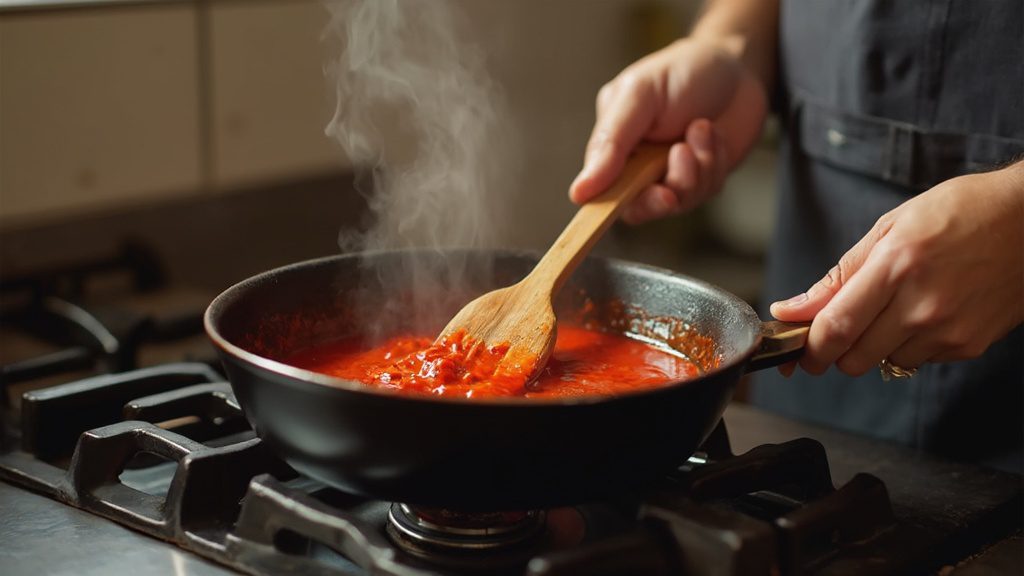
Heat changes gochujang more than most people expect. Raw, it’s bright and a little sharp — the salt and the chili sit right up front. Cooked, it goes rounder, darker, and noticeably sweeter, because the sugars start caramelizing and the raw-fermented edge cooks off. That’s why the same tablespoon can taste assertive in a dipping sauce and almost mellow in a stew, and why tasting the paste on a spoon doesn’t tell you how the finished dish will land.
The first time I ruined a batch, I was making a gochujang glaze for pork belly in an American kitchen, on an electric range I didn’t know well. I stirred the paste straight into a hot dry pan, the way I’d have added tomato paste, and walked away for maybe ninety seconds. What came back was bitter — not burnt-black, just bitter, with a scorched note running underneath everything. I served it anyway. Nobody finished it.
The fix I learned from that batch is the one I still use: fat in the pan first. A tablespoon of neutral oil or sesame oil over medium heat, then the gochujang, stirred constantly for thirty to forty seconds until it darkens a shade and smells toasty rather than raw. Korean cooks do this instinctively — it’s the same move as blooming spices in oil. The oil buffers the paste from direct pan contact, so the sugars toast instead of scorching, and the chili’s flavor compounds, which are fat-soluble, get pulled into the oil where they can spread through the dish. Skip that step and the paste tends to stay a lump of concentrated seasoning sitting in one corner of the pan.
Medium heat, not high. This is what trips up cooks who are used to searing. Gochujang’s sugar content means it goes from “toasted” to “burnt” in a few seconds at high heat, and there’s no recovering it once it does. If your pan is already hot enough for a hard sear, pull it off the burner for ten seconds before the paste goes in.
Long simmers are the opposite problem — almost none. Gochujang holds up well in a pot that’s going for an hour: the sharpness fades, the savory depth stays, the heat softens. If anything, a dish made with gochujang tastes better the next day, the way a chili does. What does change is salt concentration as the liquid reduces, so hold off on final salting until the pot is nearly done.
A few things I’ve noticed across tubs — impressions from my own cooking rather than any kind of measured comparison. Tubs where corn syrup appears high in the ingredient list caramelize faster and burn sooner, so they’re worth a lower flame and more attention. Tubs where rice sits near the top of the list behave more predictably in a glaze and taste less candied in a sauce. And gochujang labeled as traditionally fermented, the kind sold in a heavier tub, tends to carry a stronger fermented aroma that comes forward when you bloom it in oil — which some people love and some find too pungent for a first tub. Everyone lands somewhere different on that one. There’s no correct answer, only a preference you’ll discover after a few dishes.
One last practical note. If a dish tastes flat despite a generous spoonful of gochujang, the problem is usually acid, not quantity. The paste is sweet and salty and savory but not sour, so it can read as heavy with nothing to cut it. A splash of rice vinegar or a squeeze of lemon at the end will often do what a second tablespoon of paste won’t.
Buying and Storing Gochujang
Buy the plain paste in a tub, in mild or medium, and check that rice — not corn syrup — sits near the top of the ingredient list. That one sentence covers ninety percent of the decision. In most American supermarkets you’ll find it in the international or Asian aisle, shelf-stable and unrefrigerated, usually near the soy sauce and rice vinegar. Korean and pan-Asian grocery stores carry a much wider range, and every major Korean brand ships to the US now.
Paste vs pre-made gochujang sauce vs powder
Three products share the shelf, and they aren’t substitutes for one another.
Paste is the one recipes mean. It comes in a tub or a squeeze tube, thick enough to hold a spoon upright. A 500g (roughly one pound) tub is the standard size and will last a household of two several months. If you’re buying one gochujang product, buy this one.
Sauce is paste that’s already been thinned with vinegar, sugar, water, and aromatics, sold in a squeeze bottle for drizzling over rice bowls, fries, or eggs. It’s convenient and genuinely good on its own terms. It just isn’t concentrated enough to season a stew.
Powder is dehydrated gochujang, sold for dry rubs, seasoning blends, and popcorn. It carries flavor but not the paste’s body or moisture, so it can’t do the coating-and-caramelizing work a glaze needs. Useful as a second product, not as a first.
Label reading: heat rating, corn syrup vs rice, gluten
Four things are worth the ten seconds it takes to read the back of the tub.
Heat rating. Look for the pepper icons or spice number on the front. If there isn’t one, the product is probably formulated for a general American audience and sits somewhere around mild-to-medium.
First sweetener. Traditional formulas lean on rice; many mass-market ones lean on corn syrup or fructose. Neither is wrong, and I’ve cooked happily with both, but the rice-forward tubs taste less candied and behave more predictably under heat.
Wheat. This is the one people get wrong. Many commercial gochujang formulas include wheat flour or a wheat-based fermentation starter, so gochujang is not automatically gluten-free. Certified gluten-free versions exist and are labeled as such. Under FDA labeling rules, wheat is one of the major food allergens that must be declared on packaged foods sold in the US, so if wheat is in there, it’ll appear on the label. Check the allergen line, not the marketing.
Anchovy or seafood extract. Less common in gochujang than in kimchi, but a few formulations include it. Worth a glance if you’re cooking vegan.
Fridge, shelf life, and the dark ring on top
Refrigerate gochujang after opening. It’s shelf-stable sealed, but once air gets in, the fridge is where it belongs — and where it’ll keep for a year or more with no real loss of quality. USDA guidance for opened condiments follows the same principle: refrigeration slows the changes that eventually alter flavor and texture, even in high-salt products that resist spoilage.
That said, the salt and acidity make gochujang a durable product. A tub in the back of my refrigerator that’s a year past opening is still perfectly good — a little darker, a little saltier as moisture has evaporated, but entirely usable.
Which brings up the thing that alarms first-time buyers: the surface darkens over time, going from bright red to a deeper brick or near-brown, sometimes forming a slightly firmer skin around the rim. That’s oxidation, not spoilage. Stir it back in and carry on. Two habits keep it from happening quickly: press the paste flat and smooth the surface after each use so less area meets the air, and hold onto the plastic film or foil disc that came under the lid — or press a piece of plastic wrap directly onto the surface.
What would mean throw it out: fuzzy mold in white, green, or black; an off smell that reads sour-rotten rather than fermented-tangy; or a scooped-in wet spot that suggests water got in. That last one is the actual risk, so always use a clean, dry spoon. A wet spoon, or one that’s been in another dish, introduces moisture and food particles — and moisture is what turns a safe high-salt paste into something that can grow the wrong things. Every Korean kitchen I know has an unspoken rule about it, and it’s the only real handling precaution the product needs.

What to Use When You Don’t Have Gochujang
There’s no single-ingredient substitute for gochujang, and any list that tells you to “just use sriracha” is skipping the part that matters. You’re rebuilding three things at once — fermented savory depth, sweetness, and chili heat — held together in a thick paste. Get two of the three and the dish will be fine. Get one and it won’t taste like the recipe intended, though it may still taste good on its own terms.
Best all-purpose swap: miso + gochugaru + honey
This is the closest you’ll get, and the ratio is simple: 2 tablespoons miso paste + 1 tablespoon gochugaru + 1 tablespoon honey, whisked with a splash of water until it’s the consistency of tomato paste. That yields roughly 3 tablespoons of substitute, which stands in for 3 tablespoons of gochujang.
The logic maps directly onto the original. Miso supplies the fermented soybean backbone — the one component nothing else replicates. Gochugaru supplies the chili character, and specifically Korean chili character: fruity and mild rather than sharp. Honey supplies the rice-derived sweetness. Red or white miso both work; red is closer in depth, white is closer in sweetness.
If gochugaru isn’t in your pantry, ordinary crushed red pepper flakes will do, but use about two-thirds as much. American pepper flakes run hotter and sharper, and they’ll push the mixture toward heat when what you want is roundness.
Non-spicy version for kids and sensitive palates
Drop the chili entirely and replace it with sweet paprika: 2 tablespoons miso + 1 tablespoon sweet paprika + 1 tablespoon honey. You get the color, the sweetness, and the savory depth with none of the burn.
This is a genuinely useful swap for family cooking, and I’d rather someone use it than skip a Korean-inspired dish altogether. What you lose isn’t just heat — it’s the slow warmth that gives gochujang dishes their finish. Add a quarter-teaspoon of gochugaru if you want a hint of it. Kids adapt to that much more readily than people assume.
Pantry emergency: sriracha + brown sugar (and why it falls short)
1 tablespoon sriracha + 1 teaspoon brown sugar + 1 teaspoon soy sauce will stand in for 1 tablespoon of gochujang in a pinch. It’s the version most people can make right now with what’s already in the refrigerator door.
Be clear-eyed about what it does. The soy sauce contributes a little fermented savoriness, the brown sugar covers the sweetness, and the sriracha covers the heat — but sriracha also brings vinegar and garlic that gochujang doesn’t have, and the mixture stays thin. In a stew or a chili, where everything melts together anyway, it works acceptably. In a glaze, it won’t cling or caramelize the same way, and the vinegar tang sits on top of the dish instead of underneath it. Use it when the alternative is not cooking the recipe. Just don’t use it and then decide you don’t like gochujang.
What not to substitute — ketchup, harissa, sambal
Ketchup appears on a startling number of substitute lists, and I’d steer you away from it. It’s sweet and red and thick, which is where the resemblance stops: no fermented depth, no chili complexity, and a tomato acidity that reads distinctly wrong in a Korean dish. If you must, treat it as a color-and-sweetness stand-in only, and pair it with miso to do anything useful.
Harissa is an excellent paste that belongs to a different flavor world. Caraway, coriander, and cumin are doing the work there, and dropping that into bibimbap makes a dish that’s confusing rather than bad.
Sambal oelek is nearly pure ground chili with salt and vinegar — hot, sharp, no sweetness, no fermented body. It’s a fine chili source inside a substitute, paired with miso and honey, but on its own it just makes the dish spicy.
One principle covers all three: check whether your substitute brings a fermented ingredient. If it doesn’t, the dish will taste thinner than the recipe promised, no matter how much you add.
For the full breakdown — ratios by dish type, and which swaps hold up in a glaze versus a stew — my guide to gochujang substitutes that actually work goes deeper than this section can.
Gochujang FAQ
How do you pronounce gochujang?
GO-choo-jang — three syllables. “Go” as in go, “choo” as in choose, and “jang” rhyming with song rather than bang. The stress is fairly even across all three, which is typical of Korean; English speakers tend to hit the first syllable hard, and that’s close enough that nobody will misunderstand you.
The word is descriptive, not a brand name: 고추 (gochu) means chili pepper, and 장 (jang) means fermented paste or sauce. Once you know that, doenjang and ganjang stop looking like random syllables — they’re bean-jang and soy-jang, built the same way.
Is gochujang gluten-free or vegan?
Not automatically — check the label for both. Many commercial formulas include wheat flour or a wheat-based fermentation starter, so a tub is only gluten-free if it says so. Certified gluten-free gochujang is widely available in the US, and because wheat is a major food allergen under FDA labeling rules, it has to be declared on the package when it’s present.
Vegan is the easier call. The traditional recipe — chili, rice, fermented soybean, salt — contains no animal ingredients, and most tubs on an American shelf are vegan by default. The exception is a small number of formulations that add anchovy or other seafood extract for depth, which will show up in the ingredient list. A ten-second read of the back of the tub settles both questions.
Does gochujang need to be refrigerated?
Sealed, no. Opened, yes. Unopened tubs are shelf-stable and sit unrefrigerated in the store. Once you break the seal, the refrigerator is where it goes, and it’ll hold there for a year or more.
The salt content means it isn’t going to spoil quickly at room temperature, but refrigeration slows the flavor and texture changes that come with oxidation and moisture loss. Keeping the surface pressed flat and covered — and only ever going in with a clean, dry spoon — matters as much as the temperature does.
Is gochujang the same as gochugaru or doenjang?
No to both, and the difference changes how a dish tastes. Gochugaru is the dried Korean chili flake — an ingredient inside gochujang, with heat and a mild fruity note but none of the paste’s sweetness, body, or fermented depth. Doenjang is Korean fermented soybean paste, savory and pungent with no chili at all.
Think of gochujang as one paste built from parts: gochugaru contributes the pepper, the soybean fermentation contributes what doenjang has, and rice contributes the sweetness and thickness neither of the others brings. That’s also why the best substitute recipes combine a fermented soybean paste with chili flakes and a sweetener — you’re reassembling the parts.

I grew up with a tub of this in the refrigerator door, and I still think the fastest way to understand gochujang is to stop comparing it to hot sauce. It’s a fermented paste — sweet and savory first, warm at the finish — which is why one tablespoon in a pan of vegetables reads as depth rather than heat. If you’re starting tonight, keep it simple: buy the mild or medium tub, loosen a spoonful in a little oil or broth before it hits the rest of the dish, taste, then add more. And if the tub isn’t in your kitchen yet, the miso-and-gochugaru workaround will get you close enough to finish dinner. When you’re ready to go further, my guide to gochujang substitutes that actually work breaks down the ratios, and gochugaru vs gochujang explains why those two aren’t interchangeable — a mix-up I’ve seen cost people a whole pot of stew. Cook with it a few times and the guessing stops on its own.
Related reading