If you’ve already swapped in the kombucha, bought the probiotic with the highest CFU count on the shelf, and still can’t tell whether anything is different, this one’s for you. The problem isn’t the advice — it’s that the advice shows up with no way to judge it. No timeline. No signal that it’s working. No line between what the research actually supports and what somebody’s trying to sell you. So here’s what a microbiome can and can’t change, which changes matter most, and how long before you’d expect to notice anything at all.

What “Fixing” Your Gut Microbiome Actually Means
There’s nothing to fix the way you’d fix a broken bone. Your gut microbiome isn’t a machine with a correct setting. It’s an ecosystem that shifts with what you feed it, and the realistic goal is a more diverse, more resilient community — not a factory reset.
That distinction changes what counts as success. The International Scientific Association for Probiotics and Prebiotics (ISAPP) defines the microbiome as the community of microorganisms plus their environment — the surrounding conditions, not just a roster of species. Which is why “kill the bad bacteria, add the good ones” is the wrong mental model. You’re not restocking a shelf. You’re changing the conditions in a room and seeing who thrives.
And there’s no single target to aim at. One of the clearest findings from the NIH’s Human Microbiome Project was how much healthy people differ from one another. Two people with no symptoms, no complaints, no reason to see a doctor can have strikingly different bacterial lineups. So when a product or a stool test tells you your microbiome is “off,” ask: off compared to whom? There’s no agreed-upon normal to be off from.
Here’s what actually moves the needle. Diet is the biggest lever most people control — specifically, how much and how many kinds of fiber reach the colon, plus regular fermented foods. Antibiotics move things hard and fast. Sleep, alcohol, and stress matter too, though the research there is softer than the diet research, and I’d be lying if I said otherwise. What doesn’t move much is your baseline pattern — the one set by your early years and your long-term eating habits. It tends to reassert itself the moment you drift back to old meals, which is the real reason most “resets” don’t hold.
I grew up eating kimchi at every meal. Breakfast included, alongside rice and soup. Nobody in my family was managing their microbiome. It was just what was on the table, three times a day, every day, for decades. That’s what American gut-health advice tends to miss: it sells interventions, when the thing driving Korean fermented-food intake was never an intervention at all. It was a default.
Fermented foods have been associated with greater microbiome diversity in some research — most notably a Stanford trial published in Cell in 2021 that compared a high-fermented-food diet against a high-fiber diet over 10 weeks. Promising, and worth taking seriously. But one trial is one trial, and it studied a pattern of eating, not a jar of anything in particular.
So let’s define “fixing” in a way you can actually use. Not eliminating specific bacteria. Not hitting a number on a test. Instead: eating in a way that supports a wider range of microbes, kept up long enough to matter, while you watch whether digestion, regularity, and how you feel after meals trend better over a span of weeks. Crude signals, yes. But they’re the ones you have at home, and they’re more honest than a percentile on a report no clinical guideline knows how to read yet.
One more reframe before we get practical. If something specific changed recently — a course of antibiotics, a bad stomach bug, a sudden shift in bowel habits — that’s a different situation from general maintenance, and it deserves its own approach instead of a generic protocol.
For the wider map of how this all fits together, see .
The Food-First Changes That Do Most of the Work
If you change only three things, change these, in this order: eat a wider variety of plants, add fermented foods you’ll actually finish, and cut back on ultra-processed food. That sequence isn’t arbitrary — it’s ranked by how much evidence backs it against how hard it is to keep up.
Fiber diversity — the “how many different plants this week” test
Variety beats volume. Most Americans fall short on fiber to begin with: the Dietary Guidelines for Americans put the recommendation at roughly 14 grams per 1,000 calories, which works out to about 25 to 30 grams a day for most adults, and national survey data has consistently shown intake well below that. But the more useful question isn’t grams. It’s how many different fiber sources you ate this week.
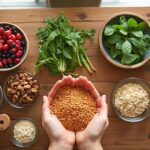
Different plants carry different fibers, and different fibers feed different microbes. Oats and barley bring beta-glucan. Beans and lentils bring resistant starch. Onions, garlic, and leeks bring inulin-type fructans. Apples and citrus bring pectin. Stick to one of those and you’re feeding one corner of the ecosystem well and the rest not at all.
So here’s a test I like: count the distinct plant foods you eat over a week. Herbs, spices, nuts, seeds, whole grains, beans — they all count. People who’ve never counted usually land somewhere around 10 to 15. Getting to 25 or 30 rarely takes new recipes. It just takes less repetition. Two kinds of beans instead of one. A bag of mixed frozen vegetables instead of the same broccoli. Sesame seeds on things.
Korean home cooking gets there almost by accident, through banchan — the small side dishes that come out with every meal. Dinner at my mother’s table might include seasoned spinach, bean sprouts, dried anchovies, braised burdock root, radish kimchi, and cabbage kimchi, all in little bowls, all in addition to the actual main dish. Nobody was optimizing anything. But six or seven plant foods hit the table before the rice did.
Fermented foods — what counts and what doesn’t
A fermented food only counts here if it contains live microbes when you eat it. That’s the line, and it rules out more than people expect.
ISAPP’s consensus statement on fermented foods draws the distinction clearly: fermented foods are made through deliberate microbial growth, but plenty of them no longer contain live cultures by the time they reach you. Sourdough bread is fermented, then baked — the heat ends it. Most soy sauce is fermented, then pasteurized. Beer and wine are fermented, though the alcohol works against you here.
What does count: yogurt with live and active cultures, kefir, unpasteurized sauerkraut from the refrigerated case, miso stirred in off the heat, tempeh, and kimchi that’s still fermenting rather than sitting in a shelf-stable jar.
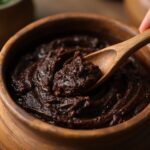
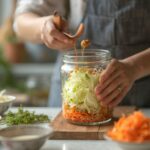
On kimchi specifically, since I get asked constantly — properly made kimchi is a live lactic acid fermentation, dominated by Lactobacillus and related species, and it keeps changing in the refrigerator. It gets sourer and fizzier over the weeks. That sourness is the fermentation continuing, which is why Koreans don’t throw out old kimchi. We cook it into stew. But shelf-stable jars sold at room temperature have usually been pasteurized, which makes them a condiment, not a source of live cultures. Check whether it came from the refrigerated section. That one habit sorts out most of the confusion.
The Stanford trial is worth coming back to for one detail: the fermented-food group worked up to roughly six servings a day. That’s a lot — closer to how fermented foods show up in Korean or Japanese eating patterns than to a spoonful of yogurt on Sunday. Frequency seems to matter more than any single food does.
What to subtract
Three subtractions carry real weight. Alcohol, which is associated with less favorable microbial patterns and is hard on the gut lining. Ultra-processed foods, which mostly do their damage by crowding out fiber. And — this one surprises people — unnecessary restriction.
I see it often enough that it’s worth naming. Someone reads about gut health, cuts gluten, cuts dairy, cuts nightshades, cuts FODMAPs, and winds up eating twelve foods on repeat. They’ve stripped out the exact variety the whole thing depends on. Elimination diets have real uses: supervised, time-limited, with a reintroduction plan. Open-ended self-imposed restriction usually works against the goal.
A sample week of swaps
Nothing dramatic. Add beans to something you already eat, twice this week. Keep a jar of refrigerated kimchi or sauerkraut around and take a forkful with dinner most nights — far more sustainable than a big serving you’ll get sick of. Swap one refined grain for a whole one. Grab a mixed frozen vegetable bag instead of a single vegetable. Put nuts or seeds on top of something.
Then give it a month before you judge it. The additions are what change the ecosystem; the subtractions mostly clear room for them.
For a fuller week-by-week version, see .

How Long It Takes — and the Signs It’s Actually Working
Measurable shifts in gut bacteria can start within a few days of a real dietary change. Shifts you can feel usually take two to four weeks. A pattern stable enough to survive a vacation or a brutal month at work takes several months. Anyone promising a fixed microbiome in seven days is selling you the timeline, not the outcome.
The gap between those numbers is where most people quit. Researchers have known for over a decade that community composition responds fast to a big dietary swing — a well-known Harvard-led study published in Nature in 2014 found detectable changes within days of switching people to an entirely plant-based or entirely animal-based diet. But that same study found something people quote far less often: composition drifted right back once the diet ended. Fast to move, fast to revert. Speed was never the hard part.
UCLA Health has put this well in its public health writing, describing resetting the gut microbiome as a long-term project rather than a quick intervention. That’s the honest version. It’s also the less marketable one, which is probably why it isn’t on any packaging.
What to actually watch, in order.
Weeks 1–2: expect turbulence, not improvement. More gas, some bloating, stools looser or firmer than usual. When you sharply increase fiber, you’re feeding fermentation in the colon, and gas is a byproduct of fermentation — a sign the fiber is reaching the microbes, not a sign something’s wrong. Ramp up over two weeks instead of overnight, drink more water, and most of this settles. If it doesn’t, mention it to a clinician rather than pushing through.
Weeks 3–4: your first honest checkpoint. Regularity is the most useful thing to track — consistent timing, stools that are formed and easy to pass, less straining. Then bloating after meals: smaller? shorter? less predictable? Then energy after eating, which is vaguer, but people do tend to notice once it changes.
Months 2–3: the question shifts from “is this different” to “does this hold.” Does regularity survive a travel week? Do foods that used to sit badly go down fine now? That resilience is closer to the real goal than any single symptom.
What I check first. When someone tells me their gut has been off and they’ve been working on it a while, I don’t start with what they’re adding. I start with three questions.
First: antibiotics. Any course in the last several months, and how the timing lines up with when things changed. That reorders everything else, and it’s covered separately in .
Second: when it started, and whether it came on gradually or abruptly. A slow drift over a year reads very differently from a Tuesday in March when something flipped. Abrupt onset with a clear date is the kind of detail that belongs in an exam room.
Third — and this is the one that most often turns out to be the answer — how much they’ve cut out. I’ve had people walk me through an elaborate gut-healing regimen while eating maybe ten distinct foods total. Four supplements added, thirty ingredients removed. The math doesn’t work no matter what’s in the capsules.
Signals that mean stop and get examined, not adjust the plan. Blood in the stool. Unintended weight loss. Persistent vomiting. Fever alongside gut symptoms. Pain that wakes you at night. New, persistent changes in bowel habits, particularly after age 45. These aren’t microbiome questions, and no quantity of fermented vegetables is the right answer to them.
For the broader list of symptoms people ask about, see .
One last thing about judging progress: don’t track it daily. Day-to-day variation in digestion is enormous and mostly noise — it swings with sleep, stress, travel, hydration, and what you ate yesterday. Pick a weekly check-in, jot down two or three things, and compare week four against week one. Almost everyone who tells me nothing changed has been evaluating it every single morning, which is a bit like weighing yourself hourly and concluding nothing works.
Probiotics, Prebiotics, and Supplements: Where the Evidence Stops
Probiotics work at the level of the specific strain for the specific condition — not as a general product category for “gut health.” That one sentence would save Americans a remarkable amount of money, and it’s essentially where the major professional guidance has landed.
In 2020, the American Gastroenterological Association published a clinical practice guideline on probiotics in gastrointestinal disorders. Its conclusions were narrow on purpose. The AGA identified a handful of situations with enough evidence to support specific formulations — preventing C. difficile infection in patients on antibiotics, pouchitis, and preterm infants among them — and for most common complaints, including general digestive symptoms in otherwise healthy adults, it did not recommend routine use. Not because probiotics were shown to be harmful, but because the evidence to recommend them wasn’t there.
That’s an uncomfortable conclusion for a category that generates billions in annual US sales. It’s also the conclusion.
Probiotic vs. prebiotic vs. fermented food — what each one does
These three get sold interchangeably, and they aren’t the same thing at all.
A probiotic, per the ISAPP definition, is a live microorganism that confers a health benefit when given in adequate amounts. Notice that the definition has a claim baked into it. If the benefit hasn’t been demonstrated for that organism at that dose, the word technically doesn’t apply — though nothing stops a label from using it anyway.
A prebiotic is a substrate your resident microbes selectively use. Food for the bacteria, essentially: inulin, fructooligosaccharides, galactooligosaccharides. You’ve been eating prebiotics all along if you eat onions, garlic, oats, or beans. It’s the fiber conversation from earlier, in supplement form.
A fermented food is a food transformed by microbial growth, which may or may not still carry live microbes by the time you eat it.
The practical difference: a probiotic delivers a defined organism at a defined dose. A fermented food delivers a mixed, undefined community plus everything else in the food — fiber, polyphenols, the metabolites produced during fermentation. Neither replaces the other. But only one of them is also dinner.
How to read a label
Look for the full strain designation, not just the species. Lactobacillus rhamnosus is a species. Lacticaseibacillus rhamnosus GG is a strain, and the “GG” is the part that’s been studied. Research findings attach to strains, so a label naming only a genus and species is telling you very little.
Then check that the CFU count is guaranteed through the end of shelf life, not “at time of manufacture.” Those are two different promises, and the second one means close to nothing after a bottle has spent four months on a warm shelf. Note the storage requirement while you’re at it — some strains need refrigeration, some are shelf-stabilized, and the label should say which.
Higher CFU is not better. It’s a dose, and the right dose is whatever was used in the study behind the claim. Fifty billion isn’t an upgraded version of ten billion any more than a double dose of anything else is automatically an improvement.
Also worth knowing: US dietary supplements aren’t approved by the FDA for effectiveness before they go on sale. Independent testing has repeatedly turned up probiotic products whose actual contents didn’t match their labels. Third-party verification helps some.
When a supplement isn’t the answer
If you’re taking a probiotic without a specific reason and a specific expected outcome, you have no way to evaluate it. That’s the core problem. No defined endpoint, no timeframe, no way to know whether to continue — so people just keep going, which is precisely what a subscription is built for.
There’s also a sequencing problem. Adding a capsule of bacteria to a diet with ten grams of fiber a day is like planting seedlings in a room with no light. Whatever shows up has nothing to eat. Get the substrate right first, then ask whether a supplement adds anything on top.
There are situations where they earn their place: during and after certain antibiotic courses, in specific diagnosed conditions, guided by someone who knows your history. Those calls belong with a clinician who can weigh them against everything else going on — especially if you’re immunocompromised, seriously ill, or have a central line, where live organisms carry real risk rather than theoretical benefit.
At-home microbiome test kits deserve a line here too. They can tell you what’s present, but no clinical guideline currently tells anyone what to do with that report. Interesting isn’t the same as actionable.

Rebuilding After Antibiotics or a Stomach Bug
After a course of antibiotics, most people’s gut bacteria return close to baseline within a couple of months — but not identically, and some species don’t come back at all. The useful approach isn’t aggressive re-seeding. It’s protecting a recovery that’s already underway and being patient with a timeline you can’t shorten by much.
A frequently cited 2018 study in Cell followed healthy adults through a course of broad-spectrum antibiotics and tracked what happened afterward. Recovery toward baseline took weeks to months. And here’s the part I find most instructive: the group given a general probiotic afterward took longer to return to their original community than the group left alone. More intervention wasn’t better. That’s one study, and it doesn’t override the AGA’s findings about specific strains in specific situations — but it should retire the idea that dumping bacteria in after antibiotics is obviously helpful.
During the course. Take the full prescription as directed. Stopping early because your gut feels off doesn’t protect your microbiome; it risks the infection you were treating in the first place. If diarrhea starts during or after antibiotics, note that the CDC identifies C. difficile infection as a known risk of antibiotic use — diarrhea that’s severe, watery, persistent, or paired with fever or abdominal pain warrants a call to your prescriber, not a trip to the supplement aisle. That’s a specific clinical situation with specific management, and it happens to be one of the narrow places where certain probiotic formulations have supporting evidence. A conversation to have with whoever wrote the prescription.
Eat normally if you can. Keep the fiber in; don’t preemptively strip your diet down.
The first week or two after. Go gentle, go gradual. If your appetite is off or things feel unsettled, this isn’t the moment to jump to thirty grams of fiber a day — that ramp is uncomfortable on a healthy gut and worse on an irritated one. Cooked vegetables tend to land easier than raw. Soups, rice, bananas, oats, well-cooked beans in small amounts.
Korean recovery food happens to be well suited to this, entirely by accident of tradition. When someone in my family was sick, what appeared was juk — rice porridge simmered until it’s nearly liquid, sometimes with abalone or vegetables, always with something small and salty alongside. Easy on the stomach, warm, still real food. Not a protocol. Just what you feed a person who isn’t well.
Weeks two through eight. Build variety back in the same order as everything else here: plants first, fermented foods layered in as tolerance returns. Start fermented foods small — a tablespoon of kimchi or sauerkraut, a few ounces of kefir — and increase over a couple of weeks. Some people find very sour, aggressively fermented kimchi rough on a recovering gut. Younger, milder kimchi goes down easier. Cooking it into a stew mellows the acidity a lot, though cooking also ends the live cultures, so treat that as a bridge rather than the destination.
After a stomach bug — norovirus, food poisoning, viral gastroenteritis. For the first day or two, the priority is fluids and electrolytes, not microbiome repair. Rehydration is the actual medical concern, and oral rehydration solutions handle it better than water alone or sports drinks, which are heavy on sugar. Return to bland food as your appetite comes back, then reintroduce fiber and fermented foods over the following week or two.
A lot of people find their digestion stays sensitive for weeks after a bad bug — bloating, urgency, foods that suddenly don’t sit right. That lingering sensitivity is common and usually settles. If it doesn’t settle after several weeks, or if it started with an identifiable illness and simply never resolved, bring it to a clinician. Post-infectious gut symptoms are a recognized pattern with real management options, and they aren’t something to keep self-managing indefinitely.
What I’d skip. Fasting protocols meant to “clear things out” when you’re already depleted. Elimination diets started mid-recovery, when you can’t tell a food reaction from an unsettled gut. Stacking four supplements at once, so that if something helps you’ll never know which. And any timeline promising restoration in a week — the biology doesn’t move that fast, and being told it should is what makes people quit on day nine.
Recovery here is mostly a matter of removing obstacles and waiting. Unsatisfying, if you want something to do. Also accurate.
The fuller version of this, including what the research says about repeated antibiotic courses over time, is in .
Frequently Asked Questions
How long does it take to fix your gut microbiome?
Expect two to four weeks before you notice anything, and two to three months before the changes hold under normal life stress. Bacterial composition shifts faster than that — within days of a real dietary change — but composition isn’t what you experience. What you experience is regularity, bloating, and how food sits, and those lag behind. Timelines vary quite a bit depending on where you’re starting from and what happened recently.
Can you fix your gut microbiome naturally, without supplements?
Yes, and for most healthy adults that’s the better-supported path. The strongest evidence sits with diet — fiber variety and regular fermented foods — rather than capsules, which is essentially where the American Gastroenterological Association’s 2020 guideline landed for general digestive complaints. Supplements have a real role in specific, narrow situations. “General gut health” isn’t one of them.
Do at-home microbiome tests tell you what to change?
Not usefully, at this point. These kits can describe what bacteria are present in a sample, but there’s no clinical consensus on what an optimal result looks like and no guideline that turns a report into a plan. The NIH’s own research showed how widely healthy people differ from each other, which undercuts the idea of scoring against a norm. If you find the data interesting, that’s a fine reason to buy one. Just don’t restrict your diet based on it.
Does kimchi count as a probiotic?
Kimchi is a fermented food, not a probiotic in the technical sense. It carries live lactic acid bacteria when it’s been properly fermented and kept refrigerated — but a probiotic, by ISAPP’s definition, requires a specific strain shown to produce a specific benefit at a specific dose, and kimchi’s microbial mix varies by recipe, by batch, and by how long it’s been sitting. It’s food that carries live cultures. That’s a good thing to have on the table most days, and it’s a different claim from what’s printed on a supplement bottle.
What symptoms mean you should stop self-managing and see a clinician?
Blood in the stool, unintended weight loss, persistent vomiting, fever with gut symptoms, pain that wakes you at night, trouble swallowing, or a new and persistent change in bowel habits — particularly after age 45. Also worth a visit: symptoms that have dragged on for months without improving, or anything that started abruptly on a date you can name. None of those are questions about fermentation. They’re questions for someone who can examine you and order the right tests.

If I had to compress all of this into one thing, it’s this: the question isn’t really how to fix your gut microbiome. It’s what you’re willing to keep doing for the next few months. In my own kitchen, the change that stuck wasn’t a protocol — it was that a jar of kimchi and a bowl of vegetables were simply always there, the way they were at my family’s table growing up. Give the food-first changes four weeks before you judge them. Watch the signals rather than the calendar. Treat any supplement as a specific tool for a specific reason instead of a general fix. And if symptoms are persistent, worsening, or new to you, bring them to a clinician who can examine you — an article can hand you a framework for thinking, but it can’t examine anyone. If you want the wider context behind these pieces, the complete guide to gut health is where I’d send you next.
Related reading